How Retatrutide Works: GIP, GLP-1 and Glucagon Receptors Explained
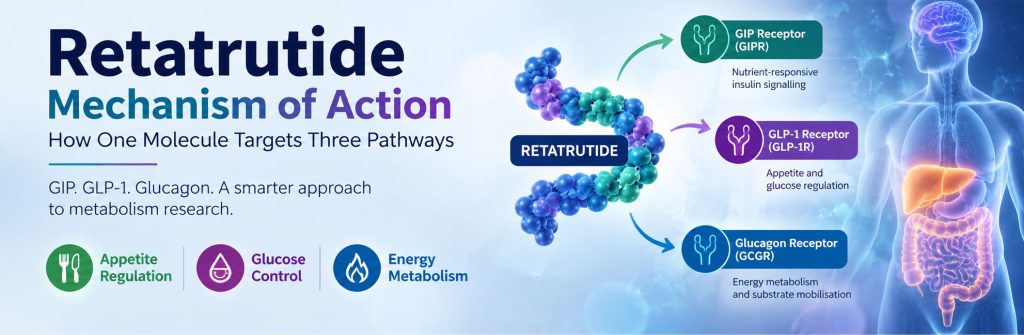
Retatrutide has attracted considerable attention in metabolic research because it does something unusual: a single molecule is designed to activate three different hormone receptors.
These are the GIP receptor, GLP-1 receptor and glucagon receptor. Each is involved in metabolic regulation, but they do not perform exactly the same job. The scientific rationale behind retatrutide is therefore not simply to stimulate three pathways at once. It is to investigate whether combining complementary metabolic signals within one molecule can produce effects that differ from targeting one pathway alone.
Thus, how does retatrutide work, and what does each receptor contribute?
Understanding the retatrutide mechanism of action requires looking at these three signalling systems separately before considering what may happen when they are activated together.
Research status: Retatrutide (LY3437943) remains an investigational compound. Clinical research findings should not be interpreted as evidence of regulatory approval or as individual medical advice.
Retatrutide Mechanism of Action at a Glance
Retatrutide is a peptide engineered to act as an agonist at three receptors:
- GIPR: glucose-dependent insulinotropic polypeptide receptor
- GLP-1R: glucagon-like peptide-1 receptor
- GCGR: glucagon receptor
An agonist can be thought of as a molecule that activates a biological receptor. If a receptor is imagined as a switch on the surface of a cell, an agonist is a signal capable of turning that switch on and initiating events inside the cell.
Retatrutide is unusual because one engineered peptide can activate all three switches.
Earlier metabolic medicines have shown the effects of targeting one or two of these pathways. Semaglutide primarily targets GLP-1 receptors, while tirzepatide combines GIP and GLP-1 receptor agonism.
Retatrutide adds glucagon receptor activity to this incretin-based approach.
For a broader introduction before exploring the molecular mechanisms, see our plain-English guide to what retatrutide is.
Simple Retatrutide Mechanism Diagram
RETATRUTIDE — ONE MOLECULE
↓ activates three receptor pathways
GIP receptor (GIPR)
↓
Nutrient-responsive insulin signalling
- metabolic signalling in several tissues
GLP-1 receptor (GLP-1R)
↓
Appetite and food-intake signalling
- glucose-dependent insulin secretion
- suppression of inappropriate glucagon secretion
Glucagon receptor (GCGR)
↓
Liver and energy-metabolism signalling
- increased substrate mobilisation
- potential contribution to energy expenditure
THREE PATHWAYS ACTING TOGETHER
↓
Combined regulation of appetite + glucose handling + energy metabolism
Diagram note: This is a simplified conceptual representation. The biological effects of retatrutide involve overlapping signalling pathways and cannot be attributed exclusively to one receptor.
What Does the GLP-1 Receptor Do?
GLP-1, or glucagon-like peptide-1, is a naturally occurring incretin hormone. It is released from the gastrointestinal tract following nutrient intake and communicates information about food intake to several parts of the body.
GLP-1 receptors are found in tissues involved in glucose regulation and appetite control.
One important effect of GLP-1 receptor activation is glucose-dependent insulin secretion. In simple terms, when glucose levels rise following a meal, GLP-1 signalling helps pancreatic beta cells to release insulin.
GLP-1 signalling can also reduce glucagon secretion when glucose concentrations are high. This matters because glucagon normally encourages the liver to release glucose.
The GLP-1 pathway additionally influences neural circuits associated with appetite, satiety and food intake.
A plain-language analogy
Think of GLP-1 signalling as part of the body’s ‘meal received’ notification system.
Food arrives, nutrients enter the circulation, and GLP-1 helps communicate:
‘Energy has arrived. Respond to the glucose and adjust further food intake accordingly.’
This analogy is simplified, but it captures why GLP-1 receptor agonism has become such an important area of metabolic research.
For retatrutide, however, GLP-1 activity represents only one part of the mechanism.
What Does the GIP Receptor Do?
GIP stands for glucose-dependent insulinotropic polypeptide. Like GLP-1, it is an incretin hormone released following food intake.
GIP receptors occur in pancreatic beta cells and several other tissues involved in nutrient and energy metabolism.
One of GIP’s best-established physiological functions is enhancing insulin secretion in response to glucose. Importantly, this effect is nutrient- and glucose-dependent rather than functioning as a simple permanent instruction to produce more insulin.
GIP biology is nevertheless more complicated than insulin secretion alone. GIP receptors are expressed across multiple tissues, and research continues into how GIP receptor signalling contributes to lipid handling, adipose biology, appetite and whole-body energy regulation.
This complexity is important when considering retatrutide.
Another analogy: the metabolic coordinator
If GLP-1 can loosely be imagined as part of the body’s meal-response notification system, GIP can be viewed as another nutrient-response coordinator.
Following food intake, it helps the body respond appropriately to incoming nutrients.
GLP-1 and GIP overlap in certain functions, but they are not interchangeable. Their receptors have different tissue distributions and can produce distinct physiological signals.
This is one reason scientists became interested in combining the pathways rather than assuming that stronger GLP-1 activation alone would necessarily be the only approach worth investigating.
Why Combine GIP and GLP-1?
GIP and GLP-1 together form an important part of what researchers call the incretin system.
The success of dual-receptor research demonstrated that a molecule does not necessarily have to be restricted to one metabolic receptor. A single engineered peptide can be designed to engage more than one signalling pathway.
Retatrutide takes this concept further.
Instead of:
GLP-1
or:
GIP + GLP-1
Its receptor profile is:
GIP + GLP-1 + glucagon
The third component changes the biological hypothesis substantially because glucagon has metabolic actions that differ from those of the two incretin hormones.
What Does the Glucagon Receptor Do?
Glucagon is often described simply as the hormone that raises blood glucose. That description is correct but incomplete.
Glucagon is produced by pancreatic alpha cells and acts prominently on the liver. When energy availability is low, glucagon signalling can encourage the liver to make stored energy available.
Glucagon receptor activation can stimulate hepatic glucose production, which may initially seem like an unusual property to incorporate into a molecule being studied for metabolic disease.
But glucagon also affects lipid metabolism, substrate utilisation and energy expenditure.
This broader metabolic activity is central to the scientific rationale for retatrutide.
Preclinical research into LY3437943 found evidence that adding glucagon receptor activity to GIP/GLP-1 agonism increased energy expenditure in experimental models. The researchers estimated that glucagon receptor activity accounted for a meaningful portion of the additional body-weight effect observed in their mouse experiments.
Animal findings cannot automatically be extrapolated to humans, but they help explain why the glucagon component was incorporated into the molecule in the first place.
The furnace analogy
A simplified way of understanding the concept is to imagine energy balance as involving both energy coming in and energy being used.
GLP-1-associated signalling can be pictured as helping turn down the amount entering the system through effects on appetite and food intake.
Glucagon receptor signalling potentially affects another side of the equation: how metabolic fuel is mobilised and used.
It is like investigating whether controlling the fuel entering a system while also influencing the furnace provides a different metabolic effect than controlling fuel intake alone.
Again, human metabolism is considerably more complicated than this analogy suggests, but it illustrates the design logic.
Why Doesn’t Glucagon Receptor Activation Simply Raise Blood Glucose?
This is one of the most intriguing aspects of the retatrutide mechanism of action.
Glucagon can increase hepatic glucose production. Taken in isolation, prolonged glucagon receptor activation might therefore appear undesirable in a compound intended for metabolic research.
Retatrutide, however, does not activate the glucagon receptor in isolation.
GLP-1 and GIP receptor signalling can enhance glucose-dependent insulin responses, while GLP-1 signalling can suppress inappropriate glucagon secretion when glucose is elevated.
The scientific hypothesis is therefore based on balancing complementary signals.
Rather than thinking of the three receptors as independent buttons producing unrelated effects, it is more useful to imagine a mixing desk with several controls.
Turning one control up may have an undesirable consequence. Adjusting several controls simultaneously may create a different overall result.
Clinical research is required to determine whether that balance translates into favourable outcomes and acceptable safety in humans.
One Molecule, Three Different Signal Pathways
Retatrutide is not a mixture of three separate hormones. It is a single engineered peptide.
The molecule, originally identified as LY3437943, was developed from a GIP peptide backbone and modified to provide agonist activity at GIP, GLP-1 and glucagon receptors.
Laboratory experiments found that the molecule activates all three human receptors, although its activity is not identical for each one.
Published discovery research describes retatrutide as having greater relative activity at the GIP receptor, with balanced activity at the GLP-1 and glucagon receptors.
This distinction is important.
Calling retatrutide a ‘triple agonist’ does not mean that it stimulates all three receptors with exactly equal potency.
The balance between receptor activities is part of the molecular design.
Researchers interested in how receptor activity is measured can also read our guide to how incretin receptors are studied in vitro.
Why Target All Three Receptors?
The simplest answer is that each receptor may contribute something different to the overall metabolic response.
| Receptor | Simplified role relevant to retatrutide research |
|---|---|
| GLP-1R | Appetite, food intake, glucose-dependent insulin signalling and glucagon regulation |
| GIPR | Nutrient-responsive insulin signalling and broader metabolic regulation |
| GCGR | Hepatic metabolism, fuel mobilisation and potential effects on energy expenditure |
The design hypothesis is therefore complementary rather than merely additive.
Researchers are investigating whether the incretin pathways can support appetite and glucose regulation while glucagon receptor agonism contributes additional effects on energy metabolism.
This concept is sometimes called the triple-agonist hypothesis.
Read our related overview of one molecule and three receptor pathways for additional background.
What Have Human Studies Shown?
Mechanistic hypotheses become scientifically meaningful only when tested in controlled studies.
A Phase 2 trial published in the New England Journal of Medicine investigated retatrutide in 338 adults with obesity or overweight plus at least one weight-related condition.
At 48 weeks, participants receiving the 12 mg dose had a mean body-weight reduction of 24.2%, compared with 2.1% with placebo.
A separate Phase 2 study published in The Lancet investigated retatrutide in people with type 2 diabetes and reported effects on glycaemic control and body weight.
These trials demonstrate that triple-receptor agonism produces measurable metabolic effects in humans, but they do not allow every observed effect to be neatly assigned to an individual receptor.
That distinction matters.
Researchers cannot look at a given percentage of weight change and say precisely what fraction resulted from GLP-1, GIP or glucagon receptor activation. The three pathways interact, and human physiology is considerably more complex than receptor experiments performed in isolated cells.
For a detailed analysis of the obesity study, see our review of what the NEJM Phase 2 retatrutide trial found.
Does Three Receptors Mean Retatrutide Is Automatically Better?
No.
The number of receptors targeted is not a ranking system.
A triple agonist is not automatically superior to a dual agonist, just as a dual agonist is not automatically superior to every single-receptor medicine.
Potential benefits must be considered alongside tolerability and safety.
Gastrointestinal adverse events were the most frequently reported adverse effects in the Phase 2 obesity trial and were generally dose-related. Also there were increases in heart rate, dose-dependent, which then declined.
These findings illustrate why receptor pharmacology cannot be considered solely in terms of potential metabolic effects.
The same pathways responsible for pharmacological activity can also contribute to adverse effects.
What Scientists Don’t Fully Understand Yet Retatrutide provides an unusual and intriguing model for the study of multi-receptor pharmacology, but important questions remain.
The exact contribution of each receptor to human outcomes is still being elucidated, as is the optimal balance between GIPR, GLP-1R and GCGR activity, whether there are differences in metabolic responses in different populations and the impact of long-term receptor activation on safety and tolerability.
Preclinical studies provide important mechanistic clues, particularly regarding glucagon receptor activity and energy expenditure. They cannot, however, establish exactly how much each pathway contributes in humans.
That requires larger and longer clinical studies alongside mechanistic research.
The Retatrutide Mechanism in Simple Terms
So, how does retatrutide work?
The simplest explanation is that retatrutide attempts to coordinate three metabolic signalling systems using one molecule.
Think of it as three interconnected controls:
GLP-1: helps regulate appetite and the glucose response to food.
GIP: supports nutrient-responsive insulin signalling and other metabolic processes.
Glucagon: influences liver metabolism, fuel mobilisation and potentially energy expenditure.
Retatrutide activates all three receptors simultaneously.
The scientific rationale is that combining appetite regulation, nutrient handling and energy metabolism may create a broader metabolic response than targeting one pathway alone.
That hypothesis is supported by preclinical mechanistic experiments and has produced substantial metabolic effects in Phase 2 human trials. However, retatrutide remains investigational, and the precise contribution of each receptor — particularly over long-term treatment — continues to be studied.
For more research-led explanations, visit the Retatrutide Knowledge Centre.
Medical and Research Disclaimer: Retatrutide is an investigational compound. This article is provided for educational and scientific information only and does not constitute medical advice. Research findings should not be interpreted as instructions for self-administration, dosing or treatment. Regulatory status and clinical evidence should be checked through appropriate official and peer-reviewed sources.
Clinical and Scientific References
- Coskun T, Urva S, Roell WC, et al. (2022).
LY3437943, a novel triple glucagon, GIP, and GLP-1 receptor agonist for glycemic control and weight loss: From discovery to clinical proof of concept. Cell Metabolism, 34(9), 1234–1247.e9.
https://doi.org/10.1016/j.cmet.2022.07.013 - Jastreboff AM, Kaplan LM, Frías JP, et al. (2023).
Triple–Hormone-Receptor Agonist Retatrutide for Obesity — A Phase 2 Trial. New England Journal of Medicine, 389, 514–526.
https://www.nejm.org/doi/full/10.1056/NEJMoa2301972 - Rosenstock J, Frias J, Jastreboff AM, et al. (2023).
Retatrutide, a GIP, GLP-1 and glucagon receptor agonist, for people with type 2 diabetes: a randomised, double-blind, placebo and active-controlled, parallel-group, phase 2 trial conducted in the USA. The Lancet, 402(10401), 529–544.
https://pubmed.ncbi.nlm.nih.gov/37385280/ - Finan B, Müller TD, Clemmensen C, et al. (2018).
Targeting the Incretin/Glucagon System With Triagonists to Treat Diabetes. Endocrine Reviews, 39(5), 719–738.
https://academic.oup.com/edrv/article/39/5/719/5036717 - Christensen M, Vedtofte L, Holst JJ, Vilsbøll T, Knop FK. (2019).
The Effects of Dual GLP-1/GIP Receptor Agonism on Glucagon Secretion—A Review. International Journal of Molecular Sciences, 20(17), 4092.
https://pubmed.ncbi.nlm.nih.gov/31443356/ - Proglucagon-derived peptides: human physiology and therapeutic potential.
Physiological Reviews. Review covering glucagon, GLP-1 receptor biology and the development of combined GLP-1/GIP/glucagon receptor agonists, including retatrutide.
https://journals.physiology.org/doi/full/10.1152/physrev.00057.2024