The Triple-Agonist Hypothesis: One Molecule, Three Receptor Pathways
Metabolic regulation involves a complex network of hormones, receptors and signalling pathways. Rather than operating independently, these systems interact to influence appetite, glucose regulation, nutrient processing and energy balance.
This complexity has led researchers to investigate whether activating several metabolic receptor pathways simultaneously could produce different effects from targeting a single pathway.
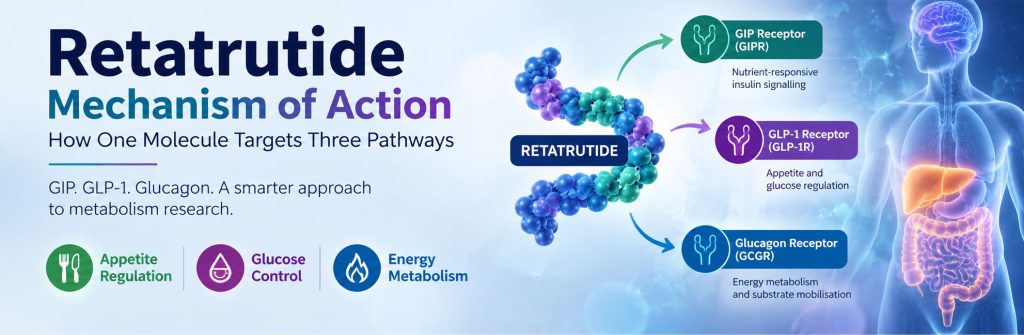
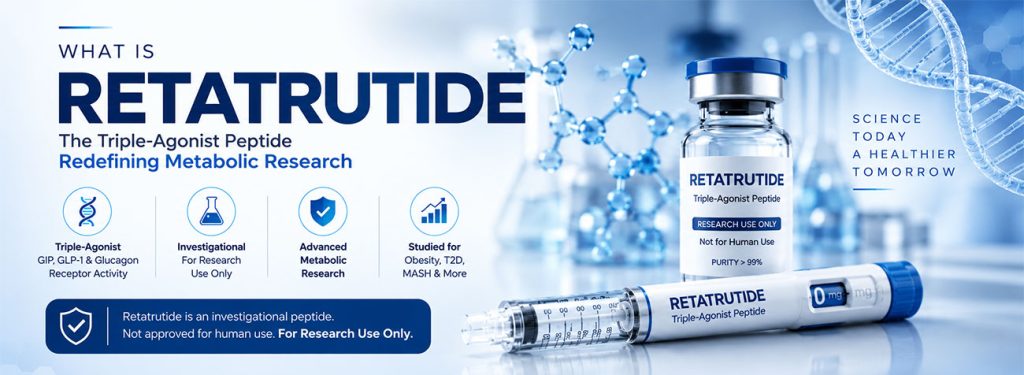
Retatrutide (LY3437943) is an investigational peptide designed around this concept. It acts as an agonist at three receptors: the glucose-dependent insulinotropic polypeptide receptor (GIPR), glucagon-like peptide-1 receptor (GLP-1R) and glucagon receptor (GCGR).
This approach is often described as triple agonism. But why combine these three pathways within one molecule, and what is the scientific hypothesis behind doing so?
What Does “Triple Agonist” Mean?
An agonist is a molecule that binds to a receptor and activates it, producing a biological signalling response.
Some metabolic medicines and experimental compounds activate a single receptor. Others have been engineered as dual agonists capable of interacting with two receptors.
Retatrutide takes the concept further by incorporating activity at three related metabolic receptors into a single peptide molecule:
- GIP receptor (GIPR)
- GLP-1 receptor (GLP-1R)
- Glucagon receptor (GCGR)
These receptors belong to the G-protein-coupled receptor family and participate in metabolic regulation, but their physiological functions are not identical.
The triple-agonist hypothesis therefore involves more than simply increasing the number of receptors activated. Researchers are studying whether carefully balanced activity across the three pathways can generate complementary metabolic effects.
Pathway One: GLP-1 Receptor Signalling
GLP-1 is an incretin hormone released primarily from intestinal L-cells following food intake. Its receptor has become one of the most extensively studied targets in modern metabolic research.
Activation of GLP-1 receptors can enhance glucose-dependent insulin secretion. GLP-1 signalling is also associated with effects on glucagon secretion, gastric emptying, appetite and food intake.
Importantly, the insulin response is glucose-dependent. This means the strength of the response is influenced by circulating glucose concentrations rather than being completely independent of them.
GLP-1 receptors are found in several tissues, including the pancreas and areas of the central nervous system involved in appetite regulation.
Within the triple-agonist model, GLP-1 receptor activity therefore provides one important component connecting nutrient intake, glucose control and appetite-related signalling.
Pathway Two: GIP Receptor Signalling
GIP is another incretin hormone released after nutrients enter the gastrointestinal tract.
Like GLP-1, GIP contributes to glucose-dependent insulin secretion through its receptors on pancreatic beta cells. However, GIP biology extends beyond the pancreas.
GIP receptors have been identified in several tissues, and researchers continue to investigate their roles in energy balance, adipose tissue biology and interactions with other metabolic pathways.
The development of dual GIP/GLP-1 receptor agonists demonstrated that these two incretin pathways can be pharmacologically combined within a single molecule.
Retatrutide extends that principle by combining GIP and GLP-1 receptor activity with a third pathway: the glucagon receptor.
Pathway Three: Glucagon Receptor Signalling
The inclusion of glucagon receptor agonism makes the triple-agonist hypothesis particularly interesting.
Glucagon is traditionally associated with increasing blood glucose, especially when glucose concentrations fall. It acts predominantly on the liver, where it can stimulate processes that increase glucose availability.
At first glance, deliberately activating the glucagon receptor alongside incretin receptors might therefore appear contradictory.
However, glucagon has broader physiological functions.
Research suggests glucagon signalling can influence energy expenditure, substrate metabolism and food intake. This has led scientists to investigate whether controlled glucagon receptor activity could complement the metabolic effects associated with GIP and GLP-1 receptor activation.
The challenge is balance. Excessive glucagon activity could potentially oppose improvements in glucose regulation. Researchers are therefore interested in whether simultaneous incretin receptor activity can counterbalance certain glycaemic effects while retaining potentially useful aspects of glucagon signalling.
Why Put Three Activities Into One Molecule?
One important feature of retatrutide is that it is a single engineered peptide, rather than three separate compounds administered together.
This gives researchers an opportunity to study coordinated receptor pharmacology within one molecular structure.
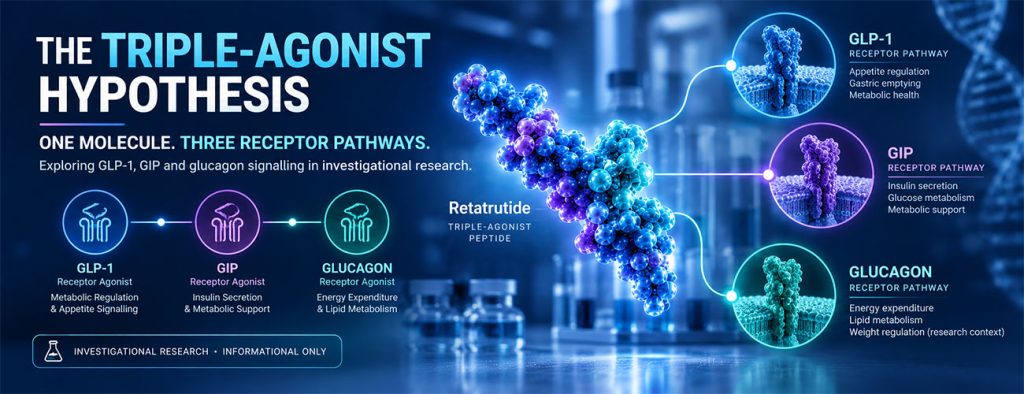
The underlying hypothesis is that the three pathways could contribute complementary effects:
- GLP-1R: glucose-dependent insulin secretion, appetite signalling and gastrointestinal effects.
- GIPR: incretin signalling and glucose-dependent insulin secretion.
- GCGR: hepatic metabolism, substrate utilisation and potential effects on energy expenditure.
The goal is not necessarily equal activation of all three receptors.
Preclinical characterisation of retatrutide has demonstrated differing activity across GIP, GLP-1 and glucagon receptors. Consequently, the relative balance of receptor activation is an important part of understanding the molecule.
What Has Research Shown So Far?
Retatrutide has progressed from laboratory and preclinical investigation into human clinical research.
A Phase 2 randomised trial published in The New England Journal of Medicine investigated retatrutide in adults with obesity. Researchers evaluated several doses over 48 weeks and reported dose-dependent reductions in body weight alongside changes in several cardiometabolic measures.
At the 12 mg dose, the mean body-weight reduction at 48 weeks was 24.2%.
These findings generated substantial scientific interest, but they do not by themselves establish exactly how much each individual receptor contributed to the observed effects.
Because GIPR, GLP-1R and GCGR are activated simultaneously, separating the contribution of each pathway in humans is scientifically challenging. Preclinical models, receptor assays, structural biology and clinical studies all provide different pieces of the overall picture.
Structural research using cryo-electron microscopy has also examined how retatrutide interacts with each of the three receptors, providing molecular-level information about its triple-receptor pharmacology.
Why Triple Agonism Matters for Metabolic Research
The broader importance of retatrutide extends beyond one investigational compound.
Triple agonism represents a shift towards multi-pathway metabolic research, where scientists attempt to reproduce or modify several aspects of natural hormonal signalling within a single engineered molecule.
It also raises important research questions. How much activity at each receptor produces an optimal biological response? How do the pathways interact over prolonged exposure? Does receptor balance influence tolerability? And can results observed in controlled clinical trials be maintained over longer periods?
These questions require continued laboratory and clinical investigation.
The Bigger Picture
The triple-agonist hypothesis reflects the increasingly sophisticated design of metabolic peptides.
Instead of viewing GIP, GLP-1 and glucagon as isolated hormonal systems, researchers are investigating how their signalling networks can interact when deliberately activated together.
Retatrutide provides an important experimental example of this approach: one molecular structure capable of engaging three distinct but interconnected receptor pathways.
Published research has produced significant findings, but retatrutide remains an investigational medicine. Continued clinical and mechanistic research is necessary to establish its long-term efficacy, safety and precise contribution of each receptor pathway.
For researchers, the significance of triple agonism may ultimately lie not simply in activating three receptors, but in understanding how the balance between those three signals changes metabolic biology.
Disclaimer: Retatrutide is an investigational compound and is not currently approved as a medicine in the UK. This content is provided for scientific and educational purposes only and does not constitute medical advice.
Scientific References
- Jastreboff AM, Kaplan LM, Frías JP, et al. Triple-Hormone-Receptor Agonist Retatrutide for Obesity — A Phase 2 Trial. New England Journal of Medicine. 2023;389:514–526. https://www.nejm.org/doi/full/10.1056/NEJMoa2301972
- Coskun T, Urva S, Roell WC, et al. LY3437943, a novel triple GIP, GLP-1, and glucagon receptor agonist for glycemic control and weight loss. Cell Metabolism. 2022. https://pubmed.ncbi.nlm.nih.gov/35931026/
- PubMed. Structural insights into retatrutide recognition and activation of GIP, GLP-1 and glucagon receptors. https://pubmed.ncbi.nlm.nih.gov/39019866/
- ClinicalTrials.gov. Clinical studies investigating LY3437943 (retatrutide). https://clinicaltrials.gov/search?term=retatrutide