How GLP-1, GIP and Glucagon Receptors Are Studied In Vitro
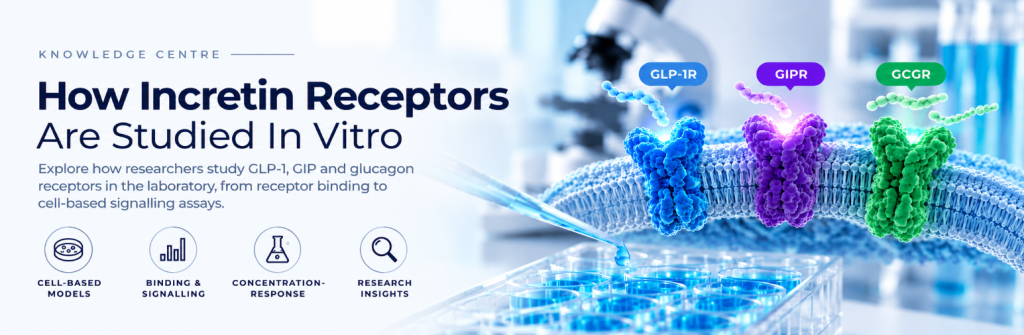
Understanding how a molecule interacts with a receptor is an important part of early-stage pharmacological research. Before researchers can examine what a compound does in more complex biological systems, they often begin with controlled laboratory experiments designed to measure receptor binding, activation and downstream signalling.
This is particularly relevant to GLP-1, GIP and glucagon receptors, three metabolic receptor pathways that have become prominent in research into multi-receptor agonists.
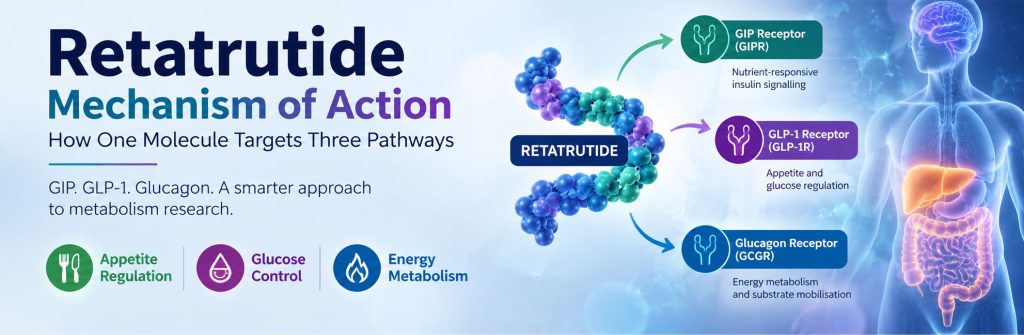
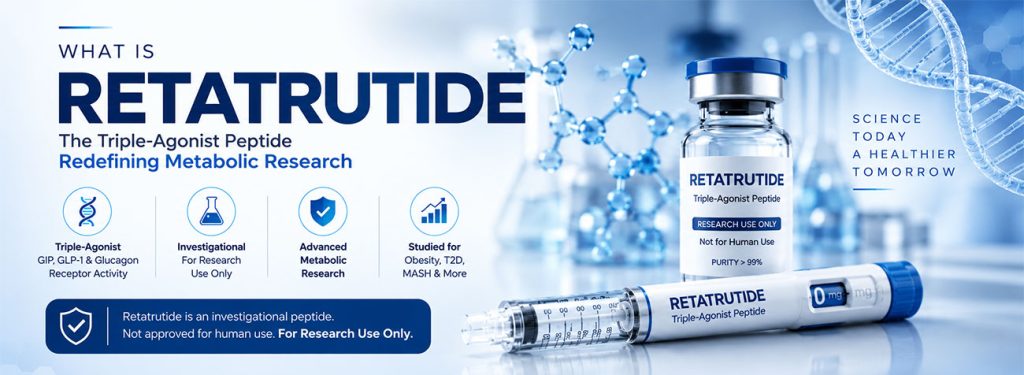
Retatrutide, also known by its development code LY3437943, is an investigational molecule designed to activate all three. Our guide to retatrutide explains the molecule and its triple-agonist design in greater detail.
But how do scientists determine whether a molecule actually activates these receptors? Much of the initial evidence comes from in vitro research.
What Does ‘In Vitro’ Mean?
“In vitro” literally means “in glass”. In modern research, the term generally refers to experiments performed outside a living organism in controlled laboratory systems.
These experiments may use cultured cells, isolated cell membranes, recombinant receptors or other biological preparations.
An in vitro experiment allows researchers to control variables that would be considerably more difficult to isolate in a whole organism. For receptor research, scientists can create cell systems expressing a particular receptor and then examine how that receptor responds when exposed to different concentrations of a test compound.
This makes it possible to investigate questions such as:
- Does the molecule bind to the receptor?
- Does binding activate the receptor?
- How potent is the molecule?
- What happens as its concentration increases?
- How does its activity compare with the receptor’s natural ligand or another reference compound?
These questions provide a foundation for understanding receptor pharmacology.
The Three Receptors Relevant to Retatrutide
Retatrutide is described as a GIP, GLP-1 and glucagon receptor agonist.
GLP-1 and GIP are incretin hormones. Their receptors — GLP-1R and GIPR — participate in metabolic signalling, including pathways associated with glucose regulation.
The glucagon receptor, generally abbreviated to GCGR, belongs to the same broader family of G-protein-coupled receptors but should not itself be described as an incretin receptor.
This distinction is why “GLP-1, GIP and glucagon receptors” is more scientifically precise than referring collectively to all three as incretin receptors.
Researchers interested in why these pathways are combined within one molecule can read our guide to the triple-agonist hypothesis.
Using Cell-Based Receptor Assays
One common approach is to use cultured cells engineered to express a specific human receptor.
For example, researchers studying a triple agonist can use separate cell populations expressing human GLP-1R, GIPR or GCGR. The test molecule is then introduced at different concentrations, and the resulting cellular response is measured.
This approach helps scientists distinguish activity at one receptor from activity at another.
It was used during the preclinical characterisation of LY3437943. Published research by Coskun and colleagues reported experiments using HEK-293 clonal cell lines expressing human GCGR, GIPR or GLP-1R.
Rather than simply demonstrating that the molecule interacted with the receptors, the experiments allowed researchers to quantify its functional activity at each target.
Measuring cAMP Signalling
Binding to a receptor is only part of the story. Researchers also want to determine whether that interaction produces a functional signal inside the cell.
GLP-1R, GIPR and GCGR can signal through pathways involving cyclic adenosine monophosphate, better known as cAMP.
When an appropriate agonist activates these receptors, intracellular cAMP can increase. Scientists can therefore use cAMP accumulation as a measurable indicator of receptor activation.
In simple terms, imagine the receptor as a switch on the surface of a cell. Binding tells researchers whether a molecule can reach the switch. A functional assay helps determine whether the molecule actually turns that switch on and generates a measurable signal inside the cell.
In the published LY3437943 research, cAMP accumulation assays were used to characterise activity at all three human receptors.
Understanding Concentration-Response Curves
Researchers normally test more than one concentration of a molecule.
Instead, cells may be exposed to a series of progressively increasing concentrations. Scientists then measure the response produced at each concentration and plot the results as a concentration-response curve.
These curves help researchers estimate pharmacological characteristics such as potency and efficacy.
One commonly reported measurement is EC50 — the concentration required to produce 50% of the molecule’s maximal observed effect under the conditions of a particular assay.
A lower EC50 generally indicates that less of the compound was required to generate the specified response in that experimental system. However, EC50 values should not be interpreted in isolation. Cell type, receptor density, assay design and other experimental conditions can all influence the result.
Importantly, an in-vitro EC50 is not a human dose and should never be interpreted as one.
Binding Assays Versus Functional Assays
Receptor studies can broadly ask two different questions.
A binding assay investigates whether and how strongly a molecule interacts with a receptor. A functional assay examines what happens after the receptor has been engaged.
The distinction matters because receptor binding does not automatically tell researchers the magnitude or nature of the subsequent biological signal.
In the original characterisation of LY3437943, receptor engagement was also assessed using radioreceptor binding assays alongside functional cAMP experiments.
Using several experimental approaches provides researchers with stronger evidence than relying on a single assay.
Why Receptor Density Matters
Laboratory cell systems do not perfectly reproduce the conditions found in human tissues.
One particularly important variable is receptor density — the number of receptors expressed by a cell.
Very high receptor expression can amplify signalling and potentially make a compound appear more active than it would under conditions with lower receptor availability.
For this reason, researchers may use cells engineered to express relatively low receptor densities when attempting to characterise their intrinsic pharmacological activity.
The published LY3437943 experiments used low-receptor-expression cell lines for the cAMP assays. This was intended to minimise signalling amplification and allow for a clearer assessment of the molecule’s intrinsic potency and efficacy.
Moving Towards More Physiologically Relevant Cell Models
Engineered receptor systems are extremely useful, but scientists can also investigate activity in human-derived cell models where relevant receptors occur more naturally.
For LY3437943, researchers complemented recombinant receptor assays with functional experiments involving differentiated human adipocytes and human induced pluripotent stem cell-derived hepatocytes.
These experiments examined downstream functional responses rather than receptor activation alone.
This illustrates an important principle in laboratory pharmacology: researchers frequently build evidence in layers.
A receptor-binding experiment may demonstrate interaction. A signalling assay can demonstrate activation. A more physiologically relevant cell model can then investigate whether that activation produces an expected cellular response.
What In-Vitro Research Cannot Tell Us
In-vitro experiments are powerful research tools, but their limitations are equally important.
A cultured cell is not a complete organism.
Laboratory receptor assays cannot independently establish clinical efficacy, long-term safety, pharmacokinetics or how multiple organ systems will respond to a compound.
Factors such as absorption, distribution, metabolism, elimination and interactions between tissues introduce additional complexity.
This is why drug development progresses through multiple stages. Laboratory and preclinical findings may provide a rationale for further investigation, while controlled human studies examine questions that cell-based experiments cannot answer.
Readers interested in the later stages of retatrutide research can explore our retatrutide clinical trials summaries.
Why In-Vitro Receptor Studies Matter
In vitro receptor research gives scientists a controlled way to investigate the basic pharmacology of experimental molecules.
For a multi-receptor compound such as retatrutide, this approach is particularly valuable because activity needs to be characterised across three separate targets: GLP-1R, GIPR and GCGR.
Binding studies, cAMP assays, concentration-response experiments and human-derived cellular models can each provide a different piece of the pharmacological picture.
Together, these methods helped establish the scientific basis for describing LY3437943 as a triple receptor agonist before the molecule progressed into broader clinical investigation.
For laboratory research materials and associated analytical documentation, see our research collection.
Key Takeaway
Studying GLP-1, GIP and glucagon receptors in vitro involves much more than observing whether a molecule attaches to a receptor.
Researchers can examine receptor binding, intracellular signalling, concentration-response relationships and functional cellular effects. Using several complementary assays helps build a more detailed picture of how an experimental molecule behaves at its intended biological targets.
In the case of retatrutide, these laboratory methods provided important evidence of activity across GLP-1R, GIPR and GCGR. However, in-vitro findings remain one part of a much larger research process and should not be interpreted as evidence of clinical effectiveness or suitability for human use.
Research disclaimer: This article is provided for scientific and educational purposes only. Retatrutide remains an investigational compound. References to laboratory assays or published studies do not constitute medical advice or instructions for human use.