Retatrutide Beginner’s Guide: Reconstitution, Dosing & Research
Retatrutide is now one of the most commonly talked about peptides in metabolism studies. But for the uninitiated, concepts such as reconstitution, concentration, dosing, titration, vial strength and bacteriostatic water may add an unnecessary layer of confusion to this topic.
This guide aims to clear up that confusion by explaining each idea in plain language. What is retatrutide? What are the differences between vial strengths? What is reconstitution? How does one calculate concentration? How is retatrutide dosing structured in clinical studies?
What follows is not an explanation of an individualised treatment plan, but research terminology and methodology.
Before you read onThis article is educational and covers laboratory terminology and published clinical research only. It is not medical advice, and nothing here should be read as preparation or administration instructions. Research materials are supplied for in-vitro laboratory research and are not for human or veterinary use.
Quick Retatrutide Overview
Before looking at reconstitution and dosing terminology, here is a simple overview of the molecule.
| Feature | Retatrutide |
|---|---|
| Development name | LY3437943 |
| Developer | Eli Lilly |
| Molecule type | Triple receptor agonist |
| Main receptors | GLP-1 GIP Glucagon |
| Administration studied | Once weekly |
| Research areas | Obesity, type 2 diabetes and metabolic conditions |
| Development stage | Clinical research |
| Common comparison | Semaglutide and tirzepatide |
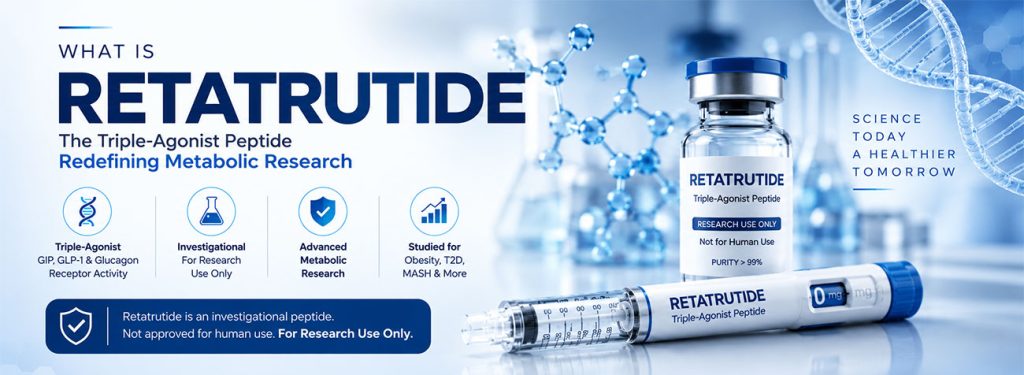
Retatrutide differs from many better-known metabolic compounds because it activates three receptor pathways simultaneously. That is why it is frequently referred to as a triple agonist.
How Does Retatrutide Work?
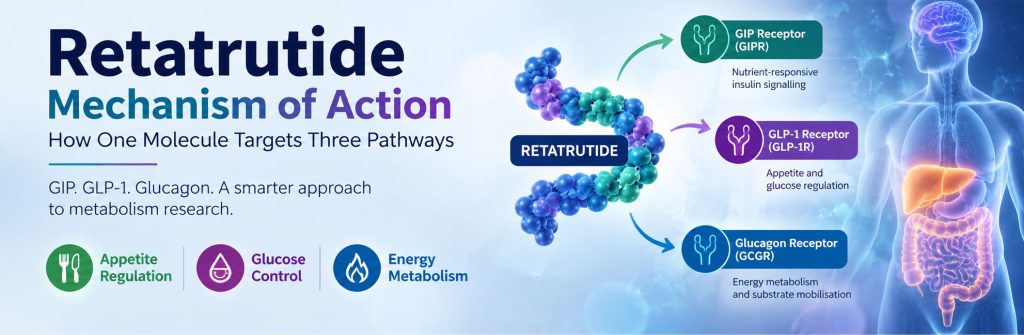
Retatrutide combines activity at three receptors: GLP-1, GIP and glucagon. Each pathway has a different role in metabolic regulation.
GLP-1
Glucagon-like peptide-1
Appetite, satiety and glucose regulation.
GIP
Glucose-dependent insulinotropic polypeptide
Insulin response and metabolic signalling.
Glucagon
Glucagon receptor
Energy expenditure and metabolic activity.
Rather than examining only one pathway, researchers are investigating whether simultaneous activation of all three may produce complementary metabolic effects. This triple-receptor mechanism is the main feature separating retatrutide from semaglutide and tirzepatide.
Retatrutide vs Tirzepatide vs Semaglutide
These three compounds are often grouped together, but their mechanisms are not identical.
| Compound | GLP-1 | GIP | Glucagon | Receptor profile |
|---|---|---|---|---|
| Semaglutide | ✓ | – | – | Single agonist |
| Tirzepatide | ✓ | ✓ | – | Dual agonist |
| Retatrutide | ✓ | ✓ | ✓ | Triple agonist |
Semaglutide focuses primarily on GLP-1 receptor activity. Tirzepatide combines GLP-1 with GIP receptor activity. Retatrutide adds glucagon receptor agonism to those two pathways.
Worth rememberingMore receptor pathways does not automatically mean one molecule is “better” than another. Differences in trial design, populations, duration and dose make direct comparisons between separate studies difficult.
What Does Retatrutide Reconstitution Mean?
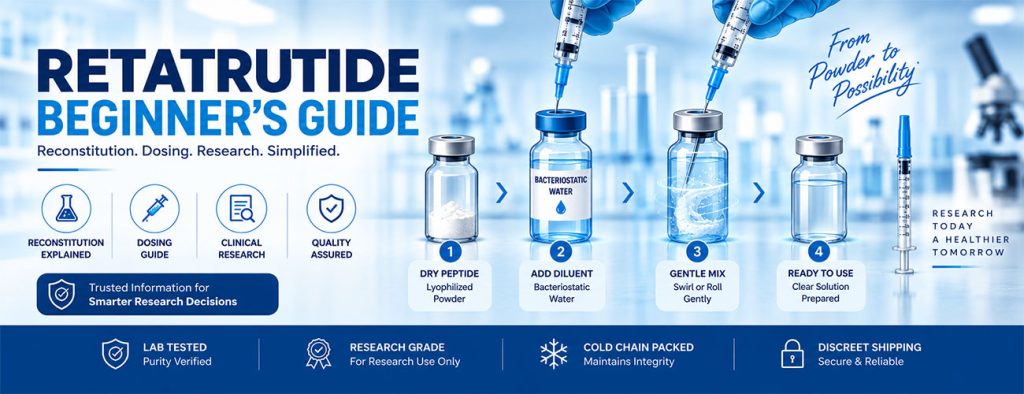
Reconstitution simply means combining a dry or lyophilised substance with a suitable liquid to create a solution. Research peptides are commonly supplied in lyophilised form because removing water can improve stability during storage and transportation.
A vial might therefore carry a labelled amount such as 5 mg, 10 mg, 15 mg, 20 mg or 30 mg.
The single most important pointThe number printed on the vial describes the total quantity of material, not its concentration. Concentration can only be calculated once the final liquid volume is known.
Vial Strength vs Concentration
This distinction causes considerable confusion for beginners.
Suppose two vials both contain 10 mg of material. If one is reconstituted to a final volume of 1 mL and another to 2 mL, they still contain the same total amount of material. Their concentrations, however, are different.
| Vial content | Final volume | Resulting concentration |
|---|---|---|
| 5 mg | 1 mL | 5 mg/mL |
| 5 mg | 2 mL | 2.5 mg/mL |
| 10 mg | 1 mL | 10 mg/mL |
| 10 mg | 2 mL | 5 mg/mL |
| 15 mg | 3 mL | 5 mg/mL |
| 20 mg | 2 mL | 10 mg/mL |
| 30 mg | 3 mL | 10 mg/mL |
These examples demonstrate concentration mathematics only. They are not recommended preparation ratios or instructions for administering retatrutide.
Understanding the Basic Calculation
The underlying calculation is straightforward:
Concentration = Total Amount ÷ Total VolumeThe relationship is mathematical, not specific to retatrutide
What Is Bacteriostatic Water?
Bacteriostatic water is sterile water that contains a small amount of benzyl alcohol as a preservative. That preservative works to inhibit bacterial growth after the vial is opened, and this is what separates bacteriostatic water from other forms of sterile water.
You will often see bacteriostatic water discussed alongside lyophilised research peptides, since a laboratory needs a suitable diluent for preparation. The correct diluent depends on the substance and the experiment itself. Something being supplied as a dry powder does not, on its own, tell you which diluent a protocol calls for.
Bacteriostatic Water vs Sterile Water
The names sound similar, but the products are not identical.
| Feature | Bacteriostatic water | Sterile water |
|---|---|---|
| Sterile | Yes | Yes |
| Contains preservative | Yes | Generally no |
| Benzyl alcohol | Typically present | Typically absent |
| Multi-entry characteristics | Preservative helps inhibit bacterial growth | Depends on product |
| Commonly discussed with peptides | Yes | Yes |
| Same product | No | No |
Researchers should always follow the specifications associated with the material and experimental protocol they are using, rather than assuming that all sterile diluents are interchangeable.
What Does “Retatrutide Dose” Mean?
A dose is simply a measured quantity used at a particular point in a research protocol. One of the most important things beginners should understand is the difference between vial strength and study dose. A vial labelled 20 mg does not mean that 20 mg represents a single dose.
| Term | Meaning |
|---|---|
| Vial strength | Total quantity contained in the vial |
| Concentration | Quantity per unit of liquid |
| Study dose | Quantity specified by a research protocol |
| Frequency | How often the protocol schedules administration |
| Escalation | Planned increase between study stages |
| Maintenance dose | Target level maintained during part of a trial |
Keeping these terms separate makes research papers much easier to understand.
What Doses Have Been Studied in Retatrutide Research?
Published retatrutide research has evaluated several dose levels. In the well-known Phase 2 obesity trial, researchers studied once-weekly retatrutide across multiple groups rather than testing only one fixed quantity. Some groups also used different starting-dose and escalation strategies before reaching their assigned target.
A simplified overview of the major target groups investigated in that study:
Target weekly doses by trial group. These figures describe clinical research groups, not personal dosing recommendations.
Some target-dose groups included different escalation approaches, making it important to read the complete trial protocol rather than interpreting the target number as a universal starting dose.
What Is Dose Escalation?
Dose escalation means progressively increasing the quantity used during a clinical study instead of beginning immediately at the final target level. It is an important concept in incretin research.
A simplified hypothetical research design might look like this:
| Research stage | Study level |
|---|---|
| Initial stage | Lower exposure |
| Escalation 1 | Increased exposure |
| Escalation 2 | Further increase |
| Target stage | Assigned study level |
The exact schedule depends on the clinical trial. Researchers use escalation designs partly because gastrointestinal tolerability can change as exposure increases. For that reason, the starting level, escalation interval and final target should be viewed as separate elements of a research protocol.
Starting Dose vs Target Dose
These two terms are commonly confused. A starting dose is the amount used at the beginning of a particular clinical protocol. A target dose is the level researchers intend participants in that group to reach after any required escalation period.
| Starting dose | Target dose |
|---|---|
| Used at beginning | Used later in protocol |
| Usually lower | Usually higher |
| Part of escalation strategy | Experimental target |
| Not necessarily maintained long term | May form maintenance stage |
Therefore, reading that a clinical trial contained a “12 mg group” does not necessarily mean participants started the study at 12 mg. The complete protocol matters.
Why Researchers Study Different Doses
Clinical researchers rarely know the optimal exposure for an investigational molecule from the beginning. Multiple groups allow investigators to examine a dose-response relationship. Researchers can compare factors such as:
- changes in body weight;
- metabolic markers;
- glucose-related outcomes;
- adverse events;
- treatment discontinuation;
- gastrointestinal tolerability; and
- differences between lower and higher exposure.
This provides much more information than testing a single quantity. It also helps researchers determine whether increasing exposure continues producing meaningful effects or primarily increases adverse events.
What Did Retatrutide Research Find?
Retatrutide attracted considerable attention following its Phase 2 obesity research. The study ran over a 48-week period, and higher dose groups showed progressive reductions in mean body weight, with outcomes differing between treatment groups.
Interest in those results came largely from the underlying question the researchers were testing: whether combining GLP-1, GIP and glucagon receptor activity produces effects beyond those seen with earlier single- and dual-receptor approaches.
Understanding mg, mL and Concentration
Three measurements appear repeatedly when reading about peptide preparation.
mg
Amount of material
How much peptide exists in total. Example: 10 mg.
mL
Liquid volume
How much liquid the material sits in. Example: 2 mL.
mg/mL
Concentration
How much material exists in each millilitre. Example: 5 mg/mL.
Mixing these measurements up is what makes a simple calculation appear complicated. The relationship between them is mathematical rather than specific to retatrutide.
Quick Concentration Reference
The following table shows how changing liquid volume mathematically changes concentration while the total quantity remains unchanged.
| Material | 1 mL final volume | 2 mL final volume | 3 mL final volume |
|---|---|---|---|
| 5 mg | 5 mg/mL | 2.5 mg/mL | 1.67 mg/mL |
| 10 mg | 10 mg/mL | 5 mg/mL | 3.33 mg/mL |
| 15 mg | 15 mg/mL | 7.5 mg/mL | 5 mg/mL |
| 20 mg | 20 mg/mL | 10 mg/mL | 6.67 mg/mL |
| 30 mg | 30 mg/mL | 15 mg/mL | 10 mg/mL |
Again, these are mathematical concentration examples, not recommended retatrutide reconstitution instructions.
Why Vial Size Matters
Different vial strengths provide different total quantities of material. For example, a 5 mg vial contains one-sixth of the total material contained in a 30 mg vial. That does not automatically make the larger vial more concentrated.
| Vial | Final volume | Concentration |
|---|---|---|
| 5 mg | 1 mL | 5 mg/mL |
| 10 mg | 2 mL | 5 mg/mL |
| 15 mg | 3 mL | 5 mg/mL |
| 20 mg | 4 mL | 5 mg/mL |
Every example produces the same mathematical concentration despite containing different total amounts. This illustrates why vial strength and concentration should never be treated as interchangeable terms.
Retatrutide Research Timeline
Retatrutide development has moved through several stages of clinical investigation. Each phase answers different scientific questions.
- Early researchExamine pharmacology and initial safety.
- Phase 1Evaluate safety, tolerability and pharmacokinetics.
- Phase 2Explore dose-response and preliminary efficacy.
- Phase 3Test efficacy and safety in larger populations.
- Ongoing researchInvestigate obesity, diabetes and related metabolic conditions.
Phase 2 results may generate excitement, but larger Phase 3 programmes matter because they involve substantially more participants and provide broader evidence about efficacy and safety.
Retatrutide Terminology for Beginners
Understanding these terms makes both clinical papers and laboratory documentation significantly easier to interpret.
Common Beginner Mistakes
Treating vial strength as a dose
The label tells you the total quantity in the vial. It says nothing about what a study protocol specifies.
Thinking more liquid means more peptide
Adding liquid changes concentration. It does not create additional material inside the vial.
Comparing milligrams across compounds
A milligram of one molecule cannot be compared with a milligram of another, because their pharmacological properties differ.
Reading trial doses as instructions
Clinical trial dosing describes a research protocol. It is not a personalised instruction of any kind.
Final Thoughts
Retatrutide can initially appear complicated because discussions often combine vial strength, reconstitution, concentration and clinical dosing into one subject. Separating them makes the terminology much easier to understand.
Vial strength describes the total quantity present. Reconstitution describes preparing a solution from dry material. Concentration describes the amount per unit of liquid. A study dose describes the quantity researchers specify within a clinical protocol.
Retatrutide itself is particularly interesting because its GLP-1, GIP and glucagon receptor activity gives researchers a triple-pathway approach to metabolic research. For beginners, understanding these fundamentals provides a much stronger foundation than simply looking at isolated dosing numbers or reconstitution charts.
Frequently Asked Questions
Retatrutide is an investigational triple receptor agonist developed by Eli Lilly. It targets GLP-1, GIP and glucagon receptors and is being studied for obesity and other metabolic conditions.
Reconstitution describes adding an appropriate liquid to a dry or lyophilised material to create a solution. The resulting concentration depends on both the amount of material and the final liquid volume.
No. Vial strength tells you the total quantity of material. Concentration describes how much material exists within a particular volume after preparation.
Mathematically, no. If a vial contains 10 mg, adding liquid does not change that total quantity. It changes the resulting concentration.
The basic laboratory calculation is Concentration = Amount ÷ Volume. For example, 10 mg in a final volume of 2 mL produces a mathematical concentration of 5 mg/mL.
Clinical studies have investigated multiple retatrutide dose levels. The Phase 2 obesity trial included target-dose groups extending from relatively low exposure through 4 mg, 8 mg and 12 mg once-weekly study groups.
Because the molecule activates three receptor systems: GLP-1, GIP and glucagon.
No. Tirzepatide is a dual GIP/GLP-1 receptor agonist. Retatrutide additionally activates the glucagon receptor, giving it a triple-receptor mechanism.
No. Semaglutide primarily acts through the GLP-1 receptor, whereas retatrutide combines GLP-1, GIP and glucagon receptor agonism.
Different vial strengths simply contain different total quantities of material. The strength printed on a vial should not be confused with concentration or a clinical study dose.