Retatrutide vs Semaglutide (Wegovy): What the Clinical Data Shows

Retatrutide and semaglutide are often mentioned together when discussing newer approaches to weight management. It is simple to understand why. Both have produced substantial weight reductions in clinical trials, both are given as injections in the major studies, and both act on hormone pathways involved in appetite and metabolism.
But they are not the same type of medicine.
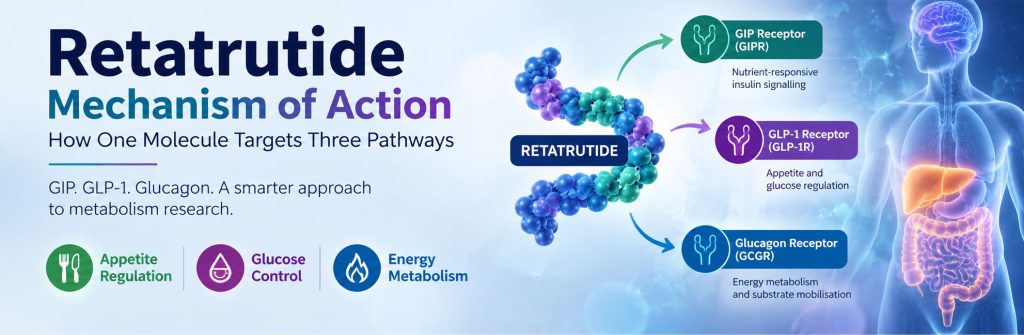
Semaglutide, sold for weight management under the brand name Wegovy, acts mainly through one hormone receptor: GLP-1. Retatrutide is designed to activate three receptors – GLP-1, GIP and glucagon – which is why it is commonly described as a triple agonist.
There is another important difference. Wegovy is an authorised medicine with an established clinical programme and is recommended by NICE for certain adults living with overweight or obesity. Retatrutide remains an investigational medicine.
Therefore, when looking at retatrutide vs semaglutide, the question is not simply which produced the bigger percentage in a trial. The studies were designed differently, ran for different lengths of time and involved different groups of participants.
Most importantly, the figures commonly quoted for the two treatments do not come from a direct head-to-head clinical trial.
Retatrutide vs Semaglutide at a Glance
| Feature | Retatrutide | Semaglutide (Wegovy) |
|---|---|---|
| Main mechanism | GLP-1, GIP and glucagon receptor agonist | GLP-1 receptor agonist |
| Often described as | Triple agonist | GLP-1 agonist |
| Key obesity evidence | Phase 2 and ongoing later-stage programme | Large Phase 3 STEP programme |
| Notable published weight result | Up to 24.2% mean reduction at 48 weeks in the 12 mg Phase 2 group | 14.9% mean reduction at 68 weeks in STEP 1 |
| UK status | Investigational; not a licensed weight-management medicine | Authorised medicine |
| Direct retatrutide vs Wegovy trial? | No established head-to-head evidence behind these quoted figures | No |
These numbers need context. A result of 24.2% in one study cannot simply be placed beside 14.9% from another and treated as proof that one medicine is more effective.
The trials were separate experiments.
These numbers need context. A 24.2% result in one study can’t be compared to 14.9% in another as proof that one medicine is more effective.
The trials were separate experiments.
The Main Scientific Difference: One Target vs Three
The easiest way to understand the difference between the two is to look at the receptors they activate.
Semaglutide: GLP-1 receptor agonism
Semaglutide is a GLP-1 receptor agonist.
GLP-1 is a naturally occurring hormone involved in several processes related to blood glucose and appetite. Semaglutide copies some of its effects and works on GLP-1 receptors.
For weight management, one of the most important effects is its influence on appetite and food intake. People may feel fuller and less hungry, which can lead to a reduction in energy intake.
This effect does not mean semaglutide simply “switches off hunger”. Human appetite is complicated and is affected by behaviour, environment, hormones, sleep, activity and many other factors.
However, GLP-1 signalling is now a well-established target for treating obesity.
The UK electronic Medicines Compendium describes Wegovy as containing semaglutide and explains that it acts on receptors involved in appetite regulation.
Retatrutide: GLP-1 + GIP + glucagon
Retatrutide takes a broader approach.
It is a single molecule designed to activate three different receptors:
GLP-1 receptors are involved in appetite, food intake and glucose regulation.
GIP receptors are part of another hormone pathway linked to metabolic responses following food intake.
Glucagon receptors have roles in glucose regulation, liver metabolism and energy balance.
This three-receptor activity is the reason retatrutide has attracted considerable scientific interest.
In the published Phase 2 obesity trial, researchers described retatrutide as an agonist of the GIP, GLP-1 and glucagon receptors.
The idea is that combining these signals within one molecule may influence energy balance differently from targeting GLP-1 alone.
That is scientifically interesting, but it should not be confused with proof that triple agonism is automatically better for every patient. Clinical outcomes, tolerability and long-term safety still matter.
What Did the Retatrutide Trial Show?
One of the most discussed studies of retatrutide was the Phase 2 obesity trial published in the New England Journal of Medicine in 2023.
The study included 338 adults with obesity or overweight plus at least one weight-related condition. Participants did not have type 2 diabetes.
Different weekly doses of retatrutide were compared with placebo over 48 weeks.
The results showed a clear dose-related pattern.
At 48 weeks, mean body-weight changes were approximately:
- 8.7% reduction with 1 mg
- 17.1% reduction with the combined 4 mg groups
- 22.8% reduction with the combined 8 mg groups
- 24.2% reduction with 12 mg
- 2.1% reduction with placebo
In the 12 mg group, 93% of participants achieved at least 10% weight reduction and 83% achieved at least 15% reduction. In addition, 26% of participants in this group reached a reduction of at least 30%.
These are substantial figures.
There was another interesting observation: at 48 weeks, the average weight-loss curve at the higher doses had not clearly reached a plateau.
That raises an obvious question about what might happen with longer treatment. However, a graph continuing downwards does not tell us what the eventual long-term result will be. Longer and larger trials are needed to answer that.
What Did the Semaglutide STEP 1 Trial Show?
Semaglutide has a much larger established evidence base for weight management.
One of its landmark studies was the STEP 1 trial, published in the New England Journal of Medicine in 2021.
STEP 1 included 1,961 adults with overweight or obesity who did not have diabetes. Participants were randomly assigned to receive once-weekly semaglutide 2.4 mg or placebo, alongside lifestyle intervention.
Treatment lasted 68 weeks.
The mean change in body weight was:
14.9% reduction with semaglutide
compared with:
2.4% reduction with placebo.
Participants receiving semaglutide also reached several clinically relevant weight-loss thresholds.
Approximately 86% achieved at least 5% weight loss, 69% achieved at least 10%, and around 50% achieved at least 15% in the main published STEP 1 analysis.
The trial therefore established that semaglutide could produce substantial weight reduction compared with lifestyle intervention plus placebo.
Importantly, the trial was part of a wider Phase 3 development programme rather than a single isolated study.
Does Retatrutide Cause More Weight Loss Than Wegovy?
This is where comparisons can become misleading.
Looking only at the headline numbers, someone might see:
Retatrutide: up to 24.2% at 48 weeks
versus
Semaglutide: 14.9% at 68 weeks
and conclude that retatrutide has been proven superior.
That conclusion is not justified by these trials.
The 24.2% and 14.9% figures came from different studies involving different participants, protocols and statistical analyses.
There was no randomisation in which one group received retatrutide and another received Wegovy under the same trial conditions.
Without that type of head-to-head comparison, differences between percentages must be interpreted cautiously.
Even seemingly small differences between clinical trials can affect results. These include baseline BMI, sex distribution, lifestyle programmes, treatment duration, dose escalation, withdrawal rates and how missing data are handled.
The correct interpretation is therefore:
Retatrutide has produced significant mean weight reductions in its clinical development programme, while semaglutide has demonstrated substantial weight reduction across an established Phase 3 programme. The separate trial results do not prove that retatrutide is superior to Wegovy.
What About Side Effects?
Both programmes have reported gastrointestinal side effects.
In the retatrutide Phase 2 trial, the most frequently reported adverse events included nausea, diarrhoea, vomiting and constipation. These events occurred more often at higher doses and were generally described as mild to moderate.
Researchers also observed dose-dependent increases in heart rate, which peaked around 24 weeks and later declined.
Gastrointestinal effects are also well recognised with semaglutide.
In STEP 1, nausea and diarrhoea were among the most common adverse events. Gastrointestinal events led some participants to discontinue treatment, although most were reported as transient and mild to moderate.
Wegovy now has considerably more accumulated clinical and regulatory information because semaglutide has progressed through a larger programme and is an authorised medicine.
That difference in evidence maturity is important when comparing the two.
Wegovy Has a Different Regulatory Position
For UK readers, perhaps the most significant practical difference between Retratutide vs Wegovy is their regulatory status.
Wegovy is an authorised prescription medicine containing semaglutide.
NICE recommends semaglutide as an option for weight management in defined circumstances and alongside a reduced-calorie diet and increased physical activity. Eligibility and treatment conditions apply, so it is not simply recommended for anyone wanting to lose weight.
Its UK product information is also available through the electronic Medicines Compendium, including dosing, indications, contraindications, warnings and adverse-effect information.
Retatrutide is different.
It remains an investigational medicine rather than an established licensed weight-management treatment. Its encouraging clinical-trial results should therefore be discussed as research findings, not as evidence for routine self-treatment.
This distinction matters particularly when websites or social media posts discuss retatrutide as though it were simply another version of Wegovy.
It is not.
Why Triple Agonism Is Generating Interest
Retatrutide’s attraction to researchers is not based solely on the headline weight-loss percentage.
Its mechanism may help scientists understand whether combining several metabolic hormone pathways can produce effects that differ from GLP-1 receptor agonism alone.
Semaglutide showed how powerful GLP-1 receptor agonism can be for weight management. Other medicines have subsequently explored combinations of hormone pathways.
Retatrutide extends that approach further by bringing GLP-1, GIP and glucagon receptor activity together.
The glucagon component is particularly interesting because glucagon is traditionally associated with raising blood glucose. Its broader role in metabolism, however, means researchers are studying whether carefully balanced glucagon receptor activity alongside incretin pathways can influence energy expenditure and fat metabolism.
The balance between the three receptor activities is therefore more important than simply saying “three is better than one”.
A medicine ultimately has to demonstrate an acceptable balance of benefits and risks in appropriately designed trials.
Semaglutide Has the Advantage of Evidence Maturity
Another way of comparing these treatments is to ask how mature the evidence is.
For semaglutide, researchers and regulators have data from thousands of participants across multiple studies. Its clinical development programme has examined different populations and outcomes, and its safety information continues to be monitored after authorisation.
Retatrutide is at a different point in that journey.
Its early and mid-stage findings have been striking, but promising results from a Phase 2 study do not replace the need for larger confirmatory trials.
This is one reason comparisons based entirely on percentage weight loss can miss the bigger picture.
For a medicine to move from an interesting clinical candidate to routine treatment, researchers need to understand much more than how much weight participants lose.
They also need evidence on safety, treatment discontinuation, longer-term outcomes, different patient groups and whether benefits remain consistent when much larger numbers of people are studied.
Retatrutide vs Wegovy: The Bottom Line
The science behind retatrutide and semaglutide overlaps, but the medicines are not interchangeable.
Semaglutide primarily targets the GLP-1 receptor. Retatrutide targets GLP-1, GIP and glucagon receptors, giving it its triple-agonist description.
The published Phase 2 retatrutide study reported mean weight reductions of up to 24.2% at 48 weeks in the highest-dose group. The STEP 1 semaglutide trial reported an average reduction of 14.9% at 68 weeks with semaglutide 2.4 mg.
Those numbers should not be treated as a head-to-head result.
They came from separate trials, and there is no basis for subtracting one percentage from the other and claiming that this represents Retratutide’s advantage over Wegovy.
The other major distinction is availability. Wegovy is an authorised medicine with established UK prescribing information and NICE guidance. Retatrutide remains investigational.
For readers who want to understand the wider clinical programme, visit our Retatrutide Knowledge Centre.
You can also view the site’s Shop for information on currently listed products and documentation.
Important: This article is for general educational information and does not provide medical advice. Retatrutide is an investigational medicine that should not be presented as a licensed alternative to Wegovy. Anyone considering treatment for obesity or weight-related health conditions should discuss appropriate licensed options with a qualified healthcare professional.
Clinical and Scientific References
- Jastreboff AM, et al. Triple–Hormone-Receptor Agonist Retatrutide for Obesity - A Phase 2 Trial. New England Journal of Medicine. 2023;389:514–526.
NEJM – Retatrutide Phase 2 Trial - Wilding JPH, et al. Once-Weekly Semaglutide in Adults with Overweight or Obesity. New England Journal of Medicine. 2021;384:989–1002. The study included UK investigators and forms a key part of the evidence base for semaglutide in obesity.
NEJM – STEP 1 Semaglutide Trial - National Institute for Health and Care Excellence (NICE). Semaglutide for managing overweight and obesity - Technology Appraisal TA875.
NICE – Semaglutide for Managing Overweight and Obesity - Electronic Medicines Compendium (emc). Wegovy - Summary of Product Characteristics. Useful for current UK-approved indications, clinical evidence, dosing and safety information.
emc – Wegovy Summary of Product Characteristics - Electronic Medicines Compendium (emc). Wegovy - Patient Information Leaflet. Provides current UK medicine information for semaglutide/Wegovy.
emc – Wegovy Patient Information Leaflet - PubMed. Wilding JPH, et al. Once-Weekly Semaglutide in Adults with Overweight or Obesity. PubMed record for the STEP 1 clinical trial.
PubMed – STEP 1 Semaglutide Study