Retatrutide vs Tirzepatide (Mounjaro): Comparing the Trial Evidence
Retatrutide and tirzepatide are two medicines attracting considerable attention in obesity and metabolic research. Both act on hormones involved in appetite, blood glucose regulation and energy balance, but they work in different ways. Tirzepatide, marketed as Mounjaro in the UK, targets two hormone receptors. Retatrutide targets three.
That difference has led to growing interest in whether retatrutide could produce greater weight loss than tirzepatide. Clinical trials have reported substantial reductions in body weight with both compounds, although the results need careful interpretation. The studies have involved different participants, treatment periods and trial designs.
There is also an important distinction in their availability. Mounjaro is an authorised prescription medicine in the UK, whereas retatrutide remains an investigational drug and is not approved for routine clinical use.
This article looks at the evidence behind retatrutide vs tirzepatide, including how they work, what clinical trials have reported, their safety profiles and what researchers still need to establish.
What Are Retatrutide and Tirzepatide?
Tirzepatide and retatrutide belong to a developing group of medicines that act on metabolic hormone receptors. These hormones help regulate how the body responds to food, manages glucose and controls hunger.
Although they share some biological targets, the two compounds are not interchangeable.
Tirzepatide (Mounjaro)
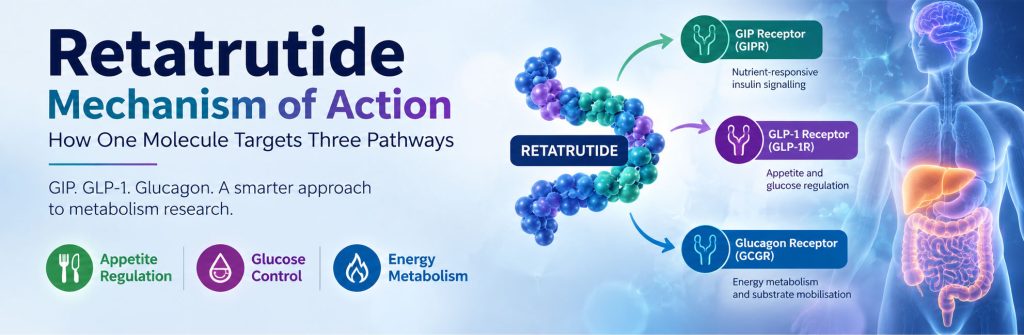
Tirzepatide is a dual glucose-dependent insulinotropic polypeptide (GIP) and glucagon-like peptide-1 (GLP-1) receptor agonist.
Both GIP and GLP-1 are incretin hormones released in response to food. They influence insulin secretion and other processes involved in glucose regulation.
By activating these receptors, tirzepatide can improve blood glucose control, reduce appetite and support weight loss.
In the UK, tirzepatide is marketed as Mounjaro. It is authorised for type 2 diabetes and weight management in eligible patients, alongside appropriate dietary and lifestyle measures.
Retatrutide
Retatrutide is an investigational triple receptor agonist developed by Eli Lilly.
It acts on three receptors:
- GLP-1 receptor
- GIP receptor
- Glucagon receptor
The additional glucagon receptor activity is the main pharmacological difference between retatrutide and tirzepatide.
Glucagon is commonly associated with raising blood glucose, but its actions are more complex. It also influences energy metabolism and fat processing. Researchers are investigating whether combining glucagon receptor activation with GLP-1 and GIP activity can produce additional metabolic effects.
Retatrutide has shown promising results in clinical trials, but it has not established the same regulatory or clinical position as tirzepatide.
Retatrutide vs Tirzepatide: How Do They Work?
The main difference is dual versus triple receptor agonism.
| Feature | Tirzepatide (Mounjaro) | Retatrutide |
| Drug class | Dual receptor agonist | Triple receptor agonist |
| GLP-1 activity | Yes | Yes |
| GIP activity | Yes | Yes |
| Glucagon receptor activity | No | Yes |
| Administration studied | Once-weekly injection | Once-weekly injection |
| Weight management evidence | Large Phase 3 programme | Phase 2 and Phase 3 evidence |
| UK regulatory status | Authorised prescription medicine | Investigational, not authorised |
GLP-1 and appetite regulation
GLP-1 receptor activation helps reduce appetite and food intake. It also influences gastric emptying and supports glucose-dependent insulin secretion.
These effects contribute to the weight reduction observed with medicines acting on the GLP-1 pathway.
GIP and metabolic regulation
GIP plays a role in insulin secretion and metabolic signalling. Its contribution to weight management is less straightforward than that of GLP-1.
When GIP and GLP-1 receptor activity are combined, as with tirzepatide, the result can be a substantial improvement in glucose control and body weight.
Why add glucagon receptor activity?
Retatrutide adds a third pathway through glucagon receptor activation.
Glucagon can affect hepatic glucose production, lipid metabolism and energy expenditure. Researchers are interested in whether carefully balanced activity across all three receptors might provide benefits beyond appetite reduction alone.
However, activating more receptors does not automatically mean a medicine is more effective or safer. The balance between these pathways matters, as do dose, tolerability and longer-term outcomes.
The clinical evidence is therefore more important than the number of receptors targeted.
What Do Clinical Trials Show About Weight Loss?
Weight loss is the main reason retatrutide and Mounjaro are frequently compared. Both have produced substantial results in clinical studies, although the evidence has developed at different stages.
Tirzepatide: Results from the SURMOUNT trials
The SURMOUNT clinical trial programme examined tirzepatide for weight management in adults with obesity or overweight.
In SURMOUNT-1, participants without diabetes received tirzepatide or placebo for 72 weeks. The study included more than 2,500 adults.
The trial reported average weight reductions of approximately:
- 16.0% with tirzepatide 5 mg
- 21.4% with tirzepatide 10 mg
- 22.5% with tirzepatide 15 mg
- 2.4% with placebo
These figures come from the analysis reported by the UK medicines regulator. Different statistical approaches in the original trial publication produce slightly different estimates.
SURMOUNT-2 studied adults with obesity or overweight and type 2 diabetes. Weight reductions were smaller than those observed in SURMOUNT-1, reaching approximately 15.7% with the 15 mg dose over 72 weeks.
This difference matters. People with type 2 diabetes often experience different weight-loss responses from those without diabetes, making the characteristics of trial participants particularly important.
Retatrutide: Phase 2 findings
An earlier Phase 2 retatrutide study, published in the New England Journal of Medicine in 2023, involved 338 adults with obesity or overweight.
Participants received different doses of retatrutide or placebo over 48 weeks.
At the highest studied dose, the trial reported an average body-weight reduction of 17.5% at 24 weeks and 24.2% at 48 weeks.
These findings attracted considerable interest because substantial weight reduction occurred within a relatively short treatment period.
Nevertheless, Phase 2 trials are generally smaller than Phase 3 studies. Their findings help establish whether further investigation is justified, but they cannot provide the same level of evidence about uncommon adverse reactions or long-term treatment outcomes.
Retatrutide: Newer Phase 3 evidence
Retatrutide’s evidence base has expanded considerably during 2026.
The Phase 3 TRIUMPH-1 trial enrolled 2,339 adults with obesity who did not have diabetes. After 80 weeks, average weight reductions reached 25.0% with the 12 mg dose, compared with 3.9% in the placebo group.
Another Phase 3 study, TRIUMPH-2, investigated retatrutide in adults with obesity and type 2 diabetes. It reported an average weight reduction of 18.8% at 80 weeks with the 12 mg dose, compared with 5.1% for placebo, using the treatment-regimen analysis.
These results strengthen the evidence that retatrutide can produce clinically meaningful weight loss across different study populations.
They do not, however, establish that retatrutide is superior to tirzepatide.
Retatrutide vs Mounjaro: Comparing the Weight-Loss Results
The following table brings together selected findings from major trials.
| Clinical trial | Medicine | Duration | Reported average weight reduction |
| SURMOUNT-1 | Tirzepatide 15 mg | 72 weeks | 22.5% |
| SURMOUNT-2 | Tirzepatide 15 mg | 72 weeks | 15.7% |
| Retatrutide Phase 2 | Retatrutide 12 mg | 48 weeks | 24.2% |
| TRIUMPH-1 | Retatrutide 12 mg | 80 weeks | 25.0% |
| TRIUMPH-2 | Retatrutide 12 mg | 80 weeks | 18.8% |
Selected trial-reported estimates. Studies used different populations and statistical analyses. These figures are not head-to-head comparisons.
Why separate trials cannot establish which medicine is better
Looking at the percentages alone, retatrutide appears to produce greater weight reductions in some studies.
But comparing results from separate trials has important limitations.
The participants were not identical. Some trials included people with type 2 diabetes, while others excluded them. Starting body weight, medical history and other characteristics also differed.
Treatment duration is another factor. A result measured after 48 weeks cannot be treated as directly equivalent to one measured after 72 or 80 weeks.
Researchers also use different statistical methods to account for participants who stop treatment or have missing measurements.
A reliable comparison would ideally involve a randomised head-to-head trial in which participants receive either retatrutide or tirzepatide under the same study conditions.
Until such comparative evidence is available, the published results support substantial weight-loss efficacy for both compounds, but do not prove that one is clinically superior.
How Do Their Effects on Blood Glucose Compare?
Weight reduction is only one part of the research.
Tirzepatide has an established role in managing type 2 diabetes. Its GIP and GLP-1 receptor activity helps improve glucose-dependent insulin secretion and overall glycaemic control.
Retatrutide has also demonstrated improvements in blood glucose measurements during clinical trials.
In TRIUMPH-2, researchers reported improvements in glycated haemoglobin (HbA1c), a measure of average blood glucose over approximately two to three months, alongside reductions in body weight.
The additional glucagon receptor activity makes retatrutide particularly interesting from a metabolic research perspective. Glucagon can increase glucose production by the liver, so its role within a triple agonist requires careful investigation.
The available findings suggest that combined receptor activity can improve metabolic outcomes despite this complexity.
However, tirzepatide has the advantage of established clinical use, regulatory assessment and a broader body of treatment experience. Retatrutide’s long-term position in diabetes care remains under investigation.
Side Effects and Safety: What Has Been Reported?
Both compounds affect gastrointestinal and metabolic pathways, so some overlap in their adverse-effect profiles is expected.
Tirzepatide safety findings
Commonly reported adverse effects of Mounjaro include nausea, diarrhoea, vomiting and constipation.
These symptoms are often more noticeable when treatment begins or the dose increases. Some people experience symptoms that are sufficiently troublesome to require changes to treatment.
There are also more serious risks requiring medical assessment, including pancreatitis, gallbladder problems, dehydration and hypoglycaemia when used with certain diabetes medicines.
Prescribers must consider medical history, other medicines and individual risk factors before treatment.
Retatrutide safety findings
Retatrutide trials have similarly reported gastrointestinal adverse effects, particularly nausea, diarrhoea and vomiting.
The earlier Phase 2 trial also identified dose-dependent increases in heart rate, which peaked during treatment and subsequently declined.
In TRIUMPH-2, investigators additionally reported hypotension and dysaesthesia, meaning unusual sensations such as tingling or altered skin sensitivity, more frequently in retatrutide groups than in the placebo group.
These observations do not necessarily mean that retatrutide has a worse overall safety profile than tirzepatide.
Different trials record adverse events under different conditions, and rare or delayed problems may only become apparent with larger populations and longer follow-up.
Safety remains an important part of retatrutide’s ongoing regulatory evaluation.
Regulatory Status in the UK
The regulatory difference between retatrutide and tirzepatide is especially important for UK readers.
Is Mounjaro approved in the UK?
Yes. The Medicines and Healthcare products Regulatory Agency (MHRA) has authorised Mounjaro for type 2 diabetes and weight management in specified patient groups.
It is a prescription-only medicine. Eligibility for treatment depends on clinical circumstances, and access through NHS services may be more restricted than the medicine’s licensed indications.
NICE guidance also informs how tirzepatide is made available for weight management within the NHS.
Is retatrutide approved in the UK?
As of November 2026, retatrutide remains investigational and is not an MHRA-authorised medicine for weight loss or diabetes treatment.
Positive clinical trial findings do not automatically result in marketing authorisation.
Regulators must evaluate the full evidence package, including efficacy, safety, manufacturing quality and the proposed conditions of use.
Products advertised online as retatrutide for human use should not be confused with authorised prescription medicines. Research-labelled material is not an approved substitute for a regulated treatment.
The MHRA also warns against obtaining unlicensed injectable weight-loss products from unregulated sellers.
What Questions Remain Unanswered?
Retatrutide’s Phase 3 findings have answered some important questions about its potential effectiveness. Others remain open.
Researchers still need to establish how its benefits and risks compare directly with established medicines, how well treatment effects persist over longer periods, and what happens when treatment is discontinued.
Cardiovascular outcomes are another important consideration. Improvements in weight, glucose or blood pressure are encouraging, but they do not automatically demonstrate a reduction in heart attacks, strokes or cardiovascular deaths.
There is also the question of tolerability in routine clinical settings, where patients may have more complex medical histories than participants selected for clinical trials.
Further evidence will help determine whether triple receptor agonism offers meaningful advantages for particular patient groups rather than simply producing a larger average change in body weight.
Conclusion
The comparison between retatrutide and tirzepatide highlights how rapidly obesity treatment research is developing.
Tirzepatide has demonstrated substantial weight-loss and glucose-control benefits and is already authorised for clinical use in the UK.
Retatrutide has produced encouraging Phase 2 and Phase 3 results, with its triple receptor activity offering a different approach to metabolic regulation.
For now, the distinction is clear: tirzepatide is an established prescription treatment, while retatrutide remains an investigational medicine. Determining whether retatrutide offers a meaningful clinical advantage will require direct comparative evidence and continued safety assessment.
Frequently Asked Questions
Retatrutide acts on three hormone receptors, while tirzepatide acts on two. Some retatrutide trials have reported greater average weight reductions, but separate studies cannot establish which medicine is more effective.
No. Mounjaro contains tirzepatide, a dual GIP/GLP-1 receptor agonist. Retatrutide is a different investigational compound that also activates glucagon receptors.
In the Phase 3 TRIUMPH-1 trial, participants receiving retatrutide 12 mg experienced an average body-weight reduction of 25.0% over 80 weeks. Individual responses varied.
No. Retatrutide has not received UK marketing authorisation and is not available as a routinely prescribed treatment.
Tirzepatide has a more established clinical safety record because it has undergone regulatory assessment and is already used in clinical practice. Retatrutide's safety continues to be evaluated.
Scientific References
- Jastreboff AM, et al. Triple–Hormone-Receptor Agonist Retatrutide for Obesity - A Phase 2 Trial. New England Journal of Medicine. 2023. Read study.
- Jastreboff AM, et al. Retatrutide, a Triple Hormone Receptor Agonist, for Treatment of Obesity. New England Journal of Medicine. 2026. Read study.
- Bellido V, et al. Retatrutide in adults with obesity and type 2 diabetes (TRIUMPH-2). The Lancet. 2026. Read study.
- MHRA. Mounjaro (tirzepatide) authorised for weight management and weight loss. 2023. Read guidance.
- MHRA. GLP-1 medicines for weight loss and diabetes: what you need to know. Updated 2026. Read guidance.
Medical disclaimer:
This article is intended for general scientific and educational information. It does not provide individual medical advice or recommend investigational compounds for human use. Decisions about prescribed weight-management treatments should be made with an appropriately qualified healthcare professional.