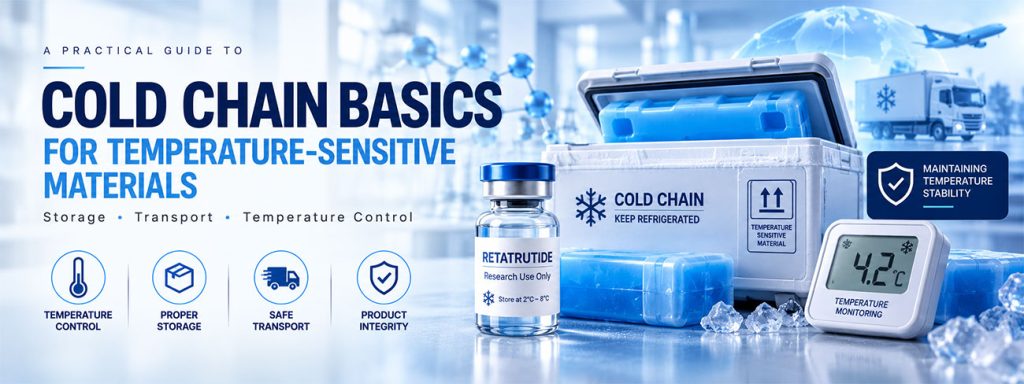
Cold-Chain Basics for Temperature-Sensitive Materials
Temperature can have a significant effect on the stability and integrity of many laboratory materials. Peptides, proteins, reagents and other temperature-sensitive compounds may undergo physical or chemical changes when they are exposed to unsuitable conditions for extended periods.
A cold chain is the controlled system used to maintain appropriate temperature conditions while materials are stored, transported and handled. For research laboratories, understanding the basic principles of cold-chain management can help protect sample integrity and improve the reliability of experimental work.
This guide looks at the fundamentals researchers should consider when working with temperature-sensitive materials, particularly lyophilised peptide material.
What Is a Cold Chain?
A cold chain is a temperature-controlled supply and storage process designed to keep sensitive materials within defined environmental conditions.
The chain may begin with manufacturing or laboratory preparation and continue through packaging, transport, receipt and storage. Temperature monitoring may also form part of the process.
The key principle is continuity. Maintaining appropriate conditions during laboratory storage is of limited value if the material has previously spent an extended period outside its specified temperature range during transport.
The World Health Organization (WHO) has developed detailed guidance covering the storage and transport of time- and temperature-sensitive products, including temperature monitoring, storage facilities and transport systems.
Why Does Temperature Matter for Peptide Research?
Peptides are chains of amino acids, and their stability can vary considerably according to their sequence, formulation and physical state.
Temperature is only one factor. Moisture, oxygen, light, pH and repeated handling may also influence stability. Certain amino-acid residues can be particularly susceptible to processes such as oxidation, hydrolysis, deamidation or photochemical degradation.
This means researchers should avoid assuming that one storage condition is appropriate for every peptide.
Published recommendations for peptide materials used in laboratory assays highlight the importance of appropriate low-temperature storage for long-term preservation and limiting repeated freeze–thaw cycles where applicable.
Lyophilised vs Reconstituted Materials
An important distinction in laboratory storage is whether a material is lyophilised or already in solution.
Lyophilisation, also known as freeze-drying, removes water from a material under controlled conditions. The resulting dry material can often have improved stability compared with the same compound in solution because many degradation reactions are influenced by the presence of water.
However, lyophilisation does not make a compound immune to environmental conditions. Researchers should still follow the storage specifications provided for the particular material or batch.
Once a peptide has been placed into solution for an experimental protocol, its stability characteristics may change substantially. The appropriate conditions will depend on factors including the peptide sequence, solvent, concentration, pH and intended analytical method.
Temperature Excursions During Transport
A temperature excursion occurs when a temperature-sensitive material moves outside its specified storage or transport range.
This does not automatically mean that a material has degraded or become unsuitable for research. The significance of an excursion depends on several variables, including:
- the temperature reached;
- how long the excursion lasted;
- the formulation and physical state of the material;
- packaging conditions;
- previous temperature exposure; and
- available stability data.
For this reason, researchers should avoid making assumptions based simply on whether a package felt warm or cold when it arrived.
Where temperature control is critical, documented transport conditions or data from calibrated temperature-monitoring devices can provide much more useful information.
Packaging and Temperature-Controlled Transport
Cold-chain packaging is designed to reduce the effect of changing external temperatures during transportation.
Depending on the material and required conditions, a shipping system may include insulated containers, thermal packaging, refrigerated transport or temperature-conditioning materials.
Effective packaging is not simply a matter of adding a cooling component. Packaging systems should be appropriate for the required temperature range, expected journey duration and environmental conditions encountered during transport.
WHO guidance on temperature-sensitive products emphasises the importance of qualified shipping containers and temperature-controlled transport systems where appropriate.
Receiving Temperature-Sensitive Research Materials
Cold-chain management does not end when a parcel reaches the laboratory.
Researchers should have a consistent procedure for receiving temperature-sensitive materials. On arrival, the package should be identified and transferred to the appropriate controlled storage environment without unnecessary delay.
Laboratory documentation may record information such as the date received, material identity, batch or lot number, packaging condition and required storage conditions.
Where a temperature-monitoring device accompanies the shipment, its data should be handled according to the laboratory’s standard operating procedure.
This creates a clearer record of the material’s history and supports research traceability.
Monitoring Laboratory Storage Conditions
A refrigerator or freezer display showing the expected temperature does not necessarily demonstrate that every area inside the unit remains at exactly the same temperature.
Temperature distribution can vary according to equipment design, loading patterns, airflow, door opening and the location of materials within the unit.
For laboratories where temperature control is important, calibrated monitoring equipment and documented temperature checks can therefore form an important part of quality management.
Temperature mapping can also identify warmer or colder areas within controlled storage equipment and help laboratories determine appropriate locations for sensitive materials.
Avoid Unnecessary Freeze–Thaw Cycles
Repeated freezing and thawing can affect some peptide and protein materials.
Where laboratory protocols require frozen solutions, researchers may consider aliquoting materials into appropriate experimental quantities before storage. This can reduce the need to repeatedly thaw an entire stock during separate experiments.
The suitability of aliquoting and frozen storage should nevertheless be determined by the characteristics of the particular compound and the validated laboratory protocol.
There is no universal storage procedure that applies to every research peptide.
Documentation Is Part of Cold-Chain Control
Good cold-chain practice is as much about documentation as refrigeration.
Laboratories may record storage conditions, temperature-monitoring results, shipment information, batch identifiers, receipt dates and any documented temperature excursions.
These records create a traceable history connecting a research material with its storage and experimental use.
When results are later reviewed, researchers can determine whether environmental conditions could have influenced sample integrity or analytical observations.
Final Considerations
Cold-chain management helps laboratories reduce unnecessary variability when working with temperature-sensitive materials.
The most important principle is to follow material-specific storage and handling information rather than relying on a universal temperature rule. Peptide stability depends on the compound, formulation, physical state and intended experimental application.
Appropriate packaging, controlled storage, temperature monitoring, careful handling and complete documentation together provide a stronger framework for protecting research materials throughout their lifecycle.
For further information on investigational peptide research, visit the Knowledge Centre or explore the site’s research products.
Research-use disclaimer: This information is provided for laboratory and educational purposes only. It is not medical advice. Research materials should be handled according to their accompanying documentation, laboratory procedures and applicable regulations.
Scientific References
-
World Health Organization (WHO).
Model guidance for the storage and transport of time- and temperature-sensitive pharmaceutical products.
WHO Technical Report Series No. 961, Annex 9, 2011.
https://www.who.int/publications/m/item/trs961-annex9-modelguidanceforstoragetransport -
World Health Organization (WHO).
Technical supplements to Model guidance for the storage and transport of time- and temperature-sensitive pharmaceutical products.
WHO Technical Report Series No. 992, Annex 5, 2015.
https://www.who.int/publications/m/item/trs992-annex5 -
World Health Organization (WHO).
How to temperature map cold chain equipment and storage areas.
Second edition, 2022.
https://www.who.int/publications/i/item/9789240042773 -
World Health Organization (WHO).
Cold chain equipment and dry store temperature mapping tool.
Guidance and tools for temperature monitoring and mapping in controlled storage environments.
https://www.who.int/publications/m/item/cold-chain-equipment-and-dry-store-temperature-mapping-tool