A Timeline of Retatrutide’s Investigational Development

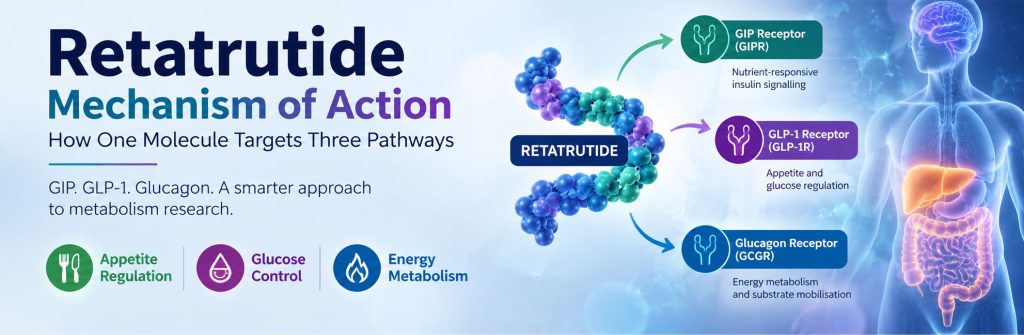
Retatrutide has attracted considerable scientific attention because it represents a different approach to incretin-based metabolic research. Rather than targeting a single receptor pathway, retatrutide is designed as a triple hormone receptor agonist, activating receptors for glucose-dependent insulinotropic polypeptide (GIP), glucagon-like peptide-1 (GLP-1) and glucagon.
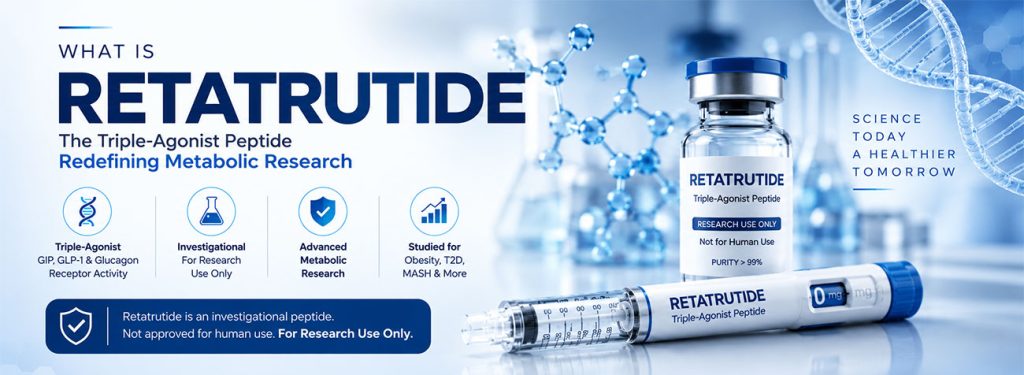
Developed by Eli Lilly under the research designation LY3437943, retatrutide remains an investigational medicine. Its development has progressed from early safety studies to large Phase 3 clinical trials investigating obesity, type 2 diabetes and several obesity-related complications.
This timeline looks at the major milestones in the investigational development of retatrutide and how the research programme has expanded over time.
2019: First-in-Human Research
One of the earliest registered clinical studies of LY3437943 began in March 2019.
This Phase 1 trial evaluated a single injection of LY3437943 in healthy participants. According to the ClinicalTrials.gov record, 45 participants were enrolled, with the study completed in July 2019.
The purpose of early-stage studies such as this is primarily to investigate safety, tolerability and how a new compound behaves in the body. They provide the initial human data needed before researchers can move into larger trials involving people with specific metabolic conditions.
This represented an important starting point in retatrutide’s clinical development.
2021–2022: Expanding Early Clinical Investigation
Following initial human studies, the retatrutide research programme expanded to investigate repeated dosing and metabolic outcomes.
Researchers became particularly interested in the compound’s three-receptor mechanism. GLP-1 and GIP receptors were already important targets in metabolic research, while adding glucagon receptor activity created an opportunity to investigate how several metabolic signalling pathways might interact within a single molecule.
This triple-agonist design is one of the key features distinguishing retatrutide from earlier incretin-based compounds.
For a closer examination of these pathways, see our guide to how retatrutide works.
2023: Phase 2 Obesity Results Published
A major milestone came in June 2023 when results from a Phase 2 obesity trial were published in the New England Journal of Medicine.
The double-blind, randomised, placebo-controlled trial enrolled 338 adults with obesity or overweight plus at least one weight-related condition. Participants received different once-weekly doses of retatrutide or placebo for 48 weeks.
Researchers assessed changes in body weight alongside safety and tolerability. The trial demonstrated a clear dose-response relationship and provided evidence supporting further investigation in larger Phase 3 studies.
Importantly, Phase 2 results are not equivalent to regulatory approval. Their role is to help researchers determine whether a candidate shows sufficient evidence of activity and an acceptable safety profile to justify larger confirmatory trials.
2023: The Phase 3 TRIUMPH Programme Begins
Following the Phase 2 programme, development moved rapidly into Phase 3.
The TRIUMPH clinical programme was designed to investigate retatrutide across obesity and several associated health conditions.
TRIUMPH-1, for example, began in July 2023 and enrolled more than 2,300 participants with obesity or overweight. The programme also included subsets of participants with knee osteoarthritis or obstructive sleep apnoea.
Other Phase 3 studies expanded investigation into populations including people with type 2 diabetes and established cardiovascular disease.
This represented an important transition: research was no longer focused simply on whether retatrutide affected body weight, but increasingly on how its metabolic effects might relate to wider obesity-associated conditions.
2025: First Positive Phase 3 Results
In December 2025, Lilly announced topline results from TRIUMPH-4, the first successful Phase 3 retatrutide trial to report results.
The study investigated adults with obesity or overweight and knee osteoarthritis who did not have diabetes. Researchers evaluated both changes in body weight and osteoarthritis-related pain.
The findings broadened scientific interest in retatrutide because the study examined outcomes beyond body weight alone.
As with all topline announcements, however, detailed peer-reviewed publications remain important for assessing trial methodology, subgroup findings and the complete safety dataset.
2026: The Phase 3 Evidence Base Expands
Retatrutide development advanced considerably during 2026.
In May, Lilly reported positive topline findings from TRIUMPH-1, which evaluated adults with obesity or overweight and at least one weight-related comorbidity without diabetes.
Further Phase 3 results followed.
In July 2026, Lilly announced positive topline results from TRIUMPH-2 and TRIUMPH-3. TRIUMPH-2 studied adults with obesity or overweight and type 2 diabetes, while TRIUMPH-3 focused on people with severe obesity and established cardiovascular disease, with or without type 2 diabetes.
Together, these trials demonstrate how the retatrutide research programme has evolved from relatively small early-phase studies into a broad clinical development programme involving different metabolic and cardiovascular populations.
What Is Being Studied Next?
The development programme continues to extend beyond general obesity research.
Current and planned studies investigate areas including type 2 diabetes, obstructive sleep apnoea, cardiovascular and renal outcomes, metabolic dysfunction-associated steatotic liver disease (MASLD), chronic low back pain and different dosing or dose-escalation strategies.
For example, TRIUMPH-9 is a Phase 3 study investigating different retatrutide dose-escalation approaches in adults with obesity or overweight without type 2 diabetes.
These studies may help researchers understand not only efficacy but also tolerability, dosing strategies and the potential relationship between weight reduction and obesity-associated complications.
Where Does Retatrutide Stand Today?
As of September 2026, retatrutide remains investigational and has not been approved by a regulatory authority.
This distinction is important. Positive Phase 2 or Phase 3 findings do not themselves establish a medicine as approved, nor do they provide the complete evidence required for clinical use.
The development of retatrutide nevertheless provides an interesting example of how metabolic research has progressed from single-receptor approaches towards molecules capable of activating several hormone receptors simultaneously.
From its first human study in 2019 to an extensive Phase 3 programme in 2026, retatrutide’s development reflects growing scientific interest in multi-receptor metabolic signalling.
Researchers interested in the underlying science can explore more articles in our Retatrutide Knowledge Centre.
Disclaimer: This article is provided for educational and scientific information only. Retatrutide remains an investigational compound and this content should not be interpreted as medical advice or as guidance for personal use.
Scientific References
- Jastreboff AM, Kaplan LM, Frías JP, et al. Triple-Hormone-Receptor Agonist Retatrutide for Obesity — A Phase 2 Trial. New England Journal of Medicine. 2023;389:514–526. https://www.nejm.org/doi/full/10.1056/NEJMoa2301972
- ClinicalTrials.gov. A Study of LY3437943 in Healthy Participants (NCT03841630). Early Phase 1 research evaluating LY3437943, later known as retatrutide. https://clinicaltrials.gov/study/NCT03841630
- ClinicalTrials.gov. A Study of Retatrutide (LY3437943) in Participants With Obesity or Overweight — TRIUMPH-1. Phase 3 clinical trial. https://clinicaltrials.gov/search?term=retatrutide%20TRIUMPH-1
- Eli Lilly and Company. Retatrutide Clinical Development and TRIUMPH Programme Updates. Official information on ongoing Phase 3 investigations and reported study results. https://www.lilly.com/news