What Is Retatrutide? A Plain-English Guide to the Triple-Agonist Molecule
Retatrutide is one of the most closely watched investigational medicines in metabolic research. Developed by Eli Lilly and Company, it belongs to a newer generation of molecules designed to act on several hormone receptors at the same time.
But what is retatrutide, and what makes it different from medicines that target only one or two metabolic pathways?
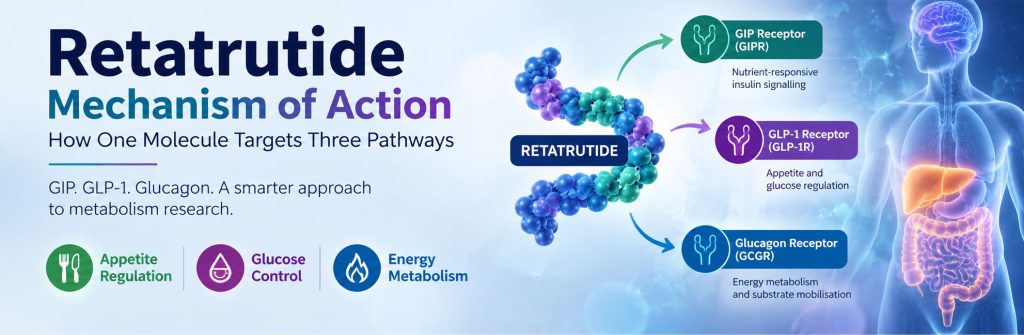
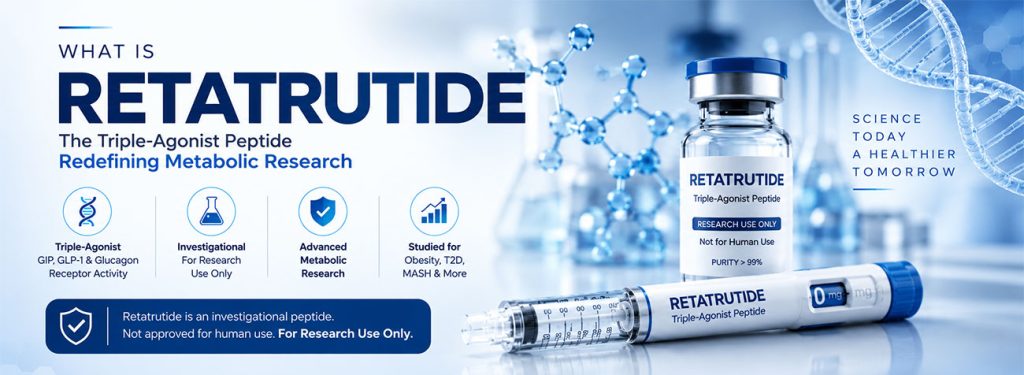
In simple terms, retatrutide is an investigational triple hormone receptor agonist. A single retatrutide molecule activates three receptors involved in metabolism: GIP, GLP-1 and glucagon receptors. Researchers are studying whether targeting these three pathways together could have useful effects on body weight, blood glucose and other aspects of metabolic health.
Investigational status: Retatrutide remains investigational. It has not been approved for general public use and its safety and effectiveness are still being reviewed in clinical trials.
What Is Retatrutide?
Retatrutide, also known by its development code LY3437943, is a molecule being developed by Eli Lilly.
It is described as a GIP, GLP-1 and glucagon receptor agonist because it is designed to activate receptors for three naturally occurring hormones involved in appetite, glucose regulation and energy metabolism.
This three-receptor approach is the reason retatrutide is commonly described as a triple agonist or tri-agonist.
Retatrutide has been studied as a once-weekly subcutaneous injection in clinical trials. Its development programme includes research into obesity, overweight, type 2 diabetes and several associated metabolic conditions.
The important distinction is that retatrutide is still an investigational medicine. Although clinical trial findings have attracted considerable attention, research findings should not be interpreted as evidence that the medicine is approved or suitable for individual use.
What Does “Triple Agonist” Mean?
The term can sound complicated, but the basic concept is relatively straightforward.
An agonist is a substance that binds to and activates a receptor. You can think of a receptor as a biological switch. When the appropriate molecule interacts with that receptor, it can trigger particular signals within the body.
Retatrutide is called a triple agonist because one molecule is designed to activate three different receptors:
- GIP- GIP receptor
- GLP-1- GLP-1 receptor
- Glucagon- Glucagon receptor
Rather than concentrating on a single pathway, researchers are investigating what happens when all three are activated by the same molecule.
You may occasionally see retatrutide informally described as “GLP-3”. This is not a scientifically accurate term. There is no “GLP-3” hormone involved in retatrutide’s mechanism. Triple agonist is the more accurate description.
The GLP-1 Part of Retatrutide
GLP-1 stands for glucagon-like peptide-1. This is a naturally occurring hormone that is involved in several eating and glucose regulation processes.
Activation of the GLP-1 receptor can influence appetite and food intake as well as the insulin and glucagon response to meals. The GLP-1 pathway is already well established in metabolic medicine and has become widely recognised because of several existing medicines acting on this receptor.
Retatrutide doesn’t just stick to GLP-1 receptor agonism, though it is part of how it works.
Its mechanism differs from drugs that act only on GLP-1 as it is acting on two other receptors simultaneously.
The GIP Part of Retatrutide
GIP stands for glucose-dependent insulinotropic polypeptide. It is another hormone released in response to food and is involved in the body’s metabolic response to nutrients.
GIP receptor signalling can influence insulin secretion and other aspects of energy metabolism.
Combining GIP and GLP-1 receptor activity is not an entirely new concept. Tirzepatide, for example, acts on both GIP and GLP-1 receptors.
Retatrutide adds a third component: glucagon receptor agonism. It is this combination of GIP + GLP-1 + glucagon activity within one molecule that has generated particular scientific interest.
The Glucagon Part of Retatrutide
Glucagon is commonly associated with its role in increasing blood glucose when levels become low. However, glucagon biology is more complex than glucose regulation alone.
Glucagon receptors are involved in energy metabolism, including processes occurring within the liver. Researchers have therefore investigated whether carefully combining glucagon receptor activity with GIP and GLP-1 receptor agonism could produce broader metabolic effects.
This does not mean that activating more receptors automatically makes a molecule better. The balance between the three pathways, the dose used and the resulting safety profile all matter.
That is precisely why controlled clinical trials are required.
Why Are Researchers Interested in Retatrutide?
Retatrutide has been the subject of much interest after the results of a Phase 2 obesity trial were published in the New England Journal of Medicine in 2023.
The trial included 338 adults who were either obese or overweight and had at least one weight-related condition. Participants received different doses of retatrutide or placebo during the 48-week treatment period.
After 48 weeks, the mean reduction in body-weight was 24.2% in the 12 mg group compared with 2.1% in the placebo group. Other dose groups of retatrutide also demonstrated varying degrees of weight reduction.
The results were encouraging enough to continue development. But Phase 2 results do not prove a medicine is fit for general use. Larger Phase 3 trials are needed to investigate efficacy and safety in wider populations.
Retatrutide has since progressed into an extensive Phase 3 clinical development programme.
What Conditions Is Retatrutide Being Studied For?
Obesity and Overweight
Obesity is one of the principal areas of retatrutide research.
Eli Lilly has run a clinical programme to study retatrutide in adults with obesity or overweight, including those with weight-related complications.
The study will examine not just how much weight participants may lose but also how the treatment impacts safety measures and health outcomes related to obesity over time.
Type 2 Diabetes
Retatrutide is also being investigated for type 2 diabetes.
This area is particularly relevant because all three hormonal pathways targeted by retatrutide have connections with glucose or energy metabolism.
Clinical studies assess measures such as blood glucose control, body weight, adverse effects and other metabolic outcomes. These studies will help determine the potential role, if any, that retatrutide could eventually have in diabetes treatment.
Metabolic Liver Disease
Retatrutide is also being studied in metabolic liver disease.
Eli Lilly’s development pipeline lists research into metabolic dysfunction-associated steatotic liver disease (MASLD). This condition involves excess fat accumulating in the liver in association with metabolic dysfunction.
More advanced inflammatory liver disease is commonly referred to as metabolic dysfunction-associated steatohepatitis (MASH).
Because obesity, insulin resistance, type 2 diabetes and liver fat can be closely connected, researchers are interested in whether therapies affecting multiple metabolic pathways could influence liver-related outcomes.
These potential applications remain subjects of clinical investigation.
Is Retatrutide the Same as Semaglutide or Tirzepatide?
No. Although the medicines are often discussed together, their receptor targets are different.
| Compound | Receptor Targets | Mechanism |
|---|---|---|
| Semaglutide | GLP-1 | Single receptor agonist |
| Tirzepatide | GIP + GLP-1 | Dual receptor agonist |
| Retatrutide | GIP + GLP-1 + glucagon | Triple receptor agonist |
Semaglutide acts primarily as a GLP-1 receptor agonist.
Tirzepatide is a dual GIP and GLP-1 receptor agonist.
Retatrutide goes one step further mechanistically by targeting GIP, GLP-1 and glucagon receptors.
This does not mean retatrutide should simply be viewed as an upgraded version of existing medicines. Different receptor combinations can produce different benefits, adverse effects and clinical considerations.
Direct comparisons need appropriate clinical evidence, not assumptions on the number of targeted receptors.
What Do We Know About Retatrutide Side Effects?
Clinical trials are designed to establish both effectiveness and safety.
In the published Phase 2 obesity study, the most frequently reported adverse events associated with retatrutide were gastrointestinal. These included nausea, diarrhoea, vomiting and constipation.
Gastrointestinal events were more common with higher doses and generally mild to moderate. They also found that heart rate increased in a dose-dependent manner, peaking during the study and then dropping.
These findings do not represent a complete long-term safety profile.
It is important to have Phase 3 trials with larger numbers of people, as they provide more information about common adverse effects, risks that are less common, people dropping out of a treatment and longer-term outcomes.
Is Retatrutide Approved in the UK?
Current Status No.
Retatrutide is still an investigational drug and not approved for general use by the public at this time.
Eli Lilly says retatrutide has not been approved by any regulatory agency and its safety and efficacy are still being evaluated through clinical trials.
This distinction is particularly important because online discussions sometimes describe retatrutide as though it were already an established weight-loss medicine.
Clinical trial results and regulatory approval are not the same thing.
A medicine must complete the appropriate development programme and undergo regulatory assessment before it can be authorised for routine clinical use.
Can You Buy Retatrutide?
Retatrutide is not currently an approved medicine available through normal UK prescribing channels.
Consumers should therefore be cautious about websites or social media accounts claiming to sell products represented as retatrutide for personal treatment.
Products offered outside legitimate clinical research cannot be assumed to have the identity, purity, strength or safety profile of the investigational medicine being studied by Eli Lilly.
People interested in weight management or diabetes treatment should discuss approved treatment options with an appropriately qualified healthcare professional rather than using an unapproved product.
Why Retatrutide Research Matters
Retatrutide represents an important development in the broader evolution of hormone-based metabolic research.
Earlier approaches often focused on a single receptor. Researchers subsequently explored dual-receptor medicines, and retatrutide is helping scientists investigate what may be possible when three complementary hormone receptors are targeted by one molecule.
The concept is scientifically interesting, but more complex does not necessarily mean more effective or safer.
The ultimate value of retatrutide will depend on the complete evidence from its clinical development programme and assessment by regulatory authorities.
Retatrutide Explained: The Key Takeaway
So, what is retatrutide?
Retatrutide is an investigational triple hormone receptor agonist developed by Eli Lilly. It activates GIP, GLP-1 and glucagon receptors within a single molecule and is being investigated across obesity, type 2 diabetes and other metabolic conditions.
There has been much interest in early- and later-stage clinical research, especially in terms of body weight and metabolic outcomes. But retatrutide is still undergoing clinical trials.
It should thus be viewed as a promising research-stage medicine, not as an approved therapy.
As further data from clinical trials emerge, researchers will be better informed about its efficacy, safety, long-term outcomes and potential role in future metabolic medicine.