Tirzepatide and Gallbladder Research
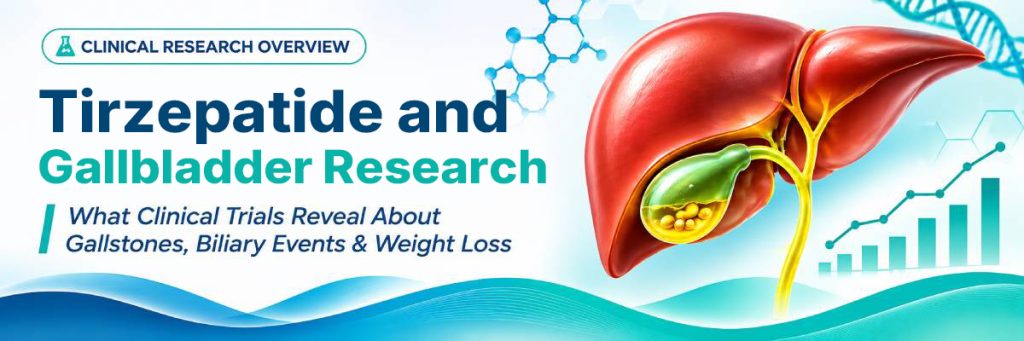
Tirzepatide is widely researched for its effects on blood sugar and body weight. However, researchers have also been looking at another aspect of its safety: whether treatment is linked to gallstones, gallbladder inflammation or other biliary problems.
Cases of gallstones, cholecystitis and other gallbladder disorders have been reported in clinical trials. These events were generally uncommon, but their occurrence has prompted further investigation.
The question is not simply whether these events have been reported. It is whether they occur more frequently with tirzepatide than with comparator treatments, how much of the risk may be associated with substantial weight loss, and whether the findings reflect a wider pattern observed with GLP-1 receptor agonists.
The available evidence suggests a possible safety signal. However, its size and underlying mechanism are not yet fully established.
There is no single explanation for this finding. The medicine may affect gallbladder function, while the substantial weight loss it produces could also play a part. Both possibilities matter when interpreting the available evidence.
So, what have the trials actually found? And how much can we conclude from the results so far?
What is the difference between gallbladder and biliary disease?
The terms gallbladder disease and biliary disease are sometimes used interchangeably, although they do not describe exactly the same conditions.
The gallbladder is a small organ where bile is stored. Bile is actually synthesised in the liver. It helps the body digest dietary fats. Biliary disorders can involve the gallbladder itself or the ducts that carry bile.
Several conditions can affect this system:
| Condition | What happens |
| Cholelithiasis | Gallstones develop in the gallbladder |
| Cholecystitis | The gallbladder becomes inflamed, often because a stone blocks its outlet |
| Biliary colic | Pain occurs when a gallstone temporarily obstructs bile flow |
| Choledocholithiasis | A gallstone is present in the common bile duct |
| Cholangitis | Infection and inflammation develop in the bile ducts, commonly following obstruction |
These outcomes should not be treated as identical when interpreting clinical trial data. A report of gallstones, for example, does not necessarily mean that a participant developed acute cholecystitis or required surgery.
What have tirzepatide clinical trials found?
Tirzepatide is a dual GIP and GLP-1 receptor agonist. Its clinical development programme includes the SURPASS trials in type 2 diabetes and the SURMOUNT trials in people with overweight or obesity.
Gallbladder-related events have been recorded across these programmes, although their frequency and the comparator groups differ.
Findings from the SURPASS programme
The SURPASS trials evaluated tirzepatide in people with type 2 diabetes. In pooled placebo-controlled phase 3 studies, cholelithiasis was reported in 0.3% of tirzepatide-treated participants, compared with none in the placebo groups.
This is a low reported frequency. However, the absence of events in the placebo group does not establish the size of an underlying risk, particularly when the total number of events is small.
A longer-term comparison is available from SURPASS-CVOT, which compared tirzepatide with dulaglutide in people with type 2 diabetes and cardiovascular disease.
An EMA assessment of this trial reported at least one gallbladder-related event in:
| Outcome | Tirzepatide | Dulaglutide |
| Any gallbladder-related event | 4.2% | 3.6% |
| Cholelithiasis | 2.4% | 2.0% |
| Acute cholecystitis | 0.9% | 0.8% |
| Chronic cholecystitis | 0.3% | 0.3% |
The difference in overall gallbladder-related events was numerical rather than statistically significant. Cholelithiasis accounted for much of the difference between the groups.
This comparison also needs context. Dulaglutide is itself a GLP-1 receptor agonist, so the study does not compare tirzepatide with an entirely untreated population.
Findings from the SURMOUNT programme
The SURMOUNT trials investigated tirzepatide for weight management. Their findings are particularly relevant because substantial weight reduction can itself influence gallstone formation.
The current UK Summary of Product Characteristics (SmPC) reports pooled results from SURMOUNT-1, SURMOUNT-2 and SURMOUNT-3.
Across these studies, cholelithiasis was reported in 1.1% of tirzepatide-treated participants and 1.0% of placebo-treated participants. Cholecystitis was reported in 0.6% and 0.2%, respectively.
The difference was more apparent for cholecystitis than for gallstones, although the absolute proportions remained relatively low.
Importantly, the SmPC also states that acute gallbladder events in the weight-management studies were positively correlated with the amount of weight reduction.
This observation does not establish that weight loss was the sole cause. It does, however, suggest that the extent of weight reduction may be relevant when interpreting these safety findings.
What do tirzepatide-specific meta-analyses show?
Individual trials may not record enough events to estimate uncommon safety outcomes precisely. Meta-analyses combine results from several studies to examine patterns across a larger participant population.
A 2023 systematic review and meta-analysis examined pancreatitis and gallbladder or biliary events in nine tirzepatide trials involving 9,871 participants.
The analysis found an increased risk of the combined outcome of gallbladder or biliary disease compared with placebo or basal insulin (relative risk 1.97; 95% confidence interval 1.14–3.42).
However, it did not establish statistically significant increases when individual outcomes such as cholelithiasis, cholecystitis and biliary disease were considered separately.
A later meta-analysis by Gong and colleagues, published in the Journal of Diabetes Investigation in 2025, included 12 randomised controlled trials involving 12,351 participants.
Its findings were:
- Gallbladder or biliary disease: relative risk 1.52 (95% CI 1.17–1.98).
- Cholelithiasis: relative risk 1.67 (95% CI 1.14–2.44).
- No statistically established dose-response relationship across the tirzepatide doses examined.
The findings suggest a possible link, but they do not establish that tirzepatide directly caused every reported event.
But there are some limitations too. The review included studies involving different patient groups, comparison treatments and follow-up periods. A 2026 critical appraisal also raised concerns about how rare events were analysed and the clinical differences between the studies included in the meta-analysis.
Does the wider GLP-1 research support this signal?
Research involving GLP-1 receptor agonists provides additional context, although it should not be confused with direct tirzepatide evidence.
A large 2022 systematic review and meta-analysis by He and colleagues included 76 randomised clinical trials and 103,371 participants.
Compared with control groups, GLP-1 receptor agonist treatment was associated with:
- A 37% higher relative risk of gallbladder or biliary disease.
- A 27% higher relative risk of cholelithiasis.
- A 36% higher relative risk of cholecystitis.
The authors also reported an absolute increase of approximately 27 gallbladder or biliary events per 10,000 patients per year.
The association was stronger in trials involving weight-loss treatment, higher doses and longer treatment duration.
However, this analysis examined GLP-1 receptor agonists, not tirzepatide as a dual GIP/GLP-1 agonist. It therefore provides class-level context rather than direct confirmation of a tirzepatide-specific effect.
Why might weight reduction influence gallbladder risk?
If there is a significant reduction in body fat, the liver could secrete more cholesterol in the bile, thus causing increased cholesterol saturation of bile and crystallisation.
In addition, the alteration of gallbladder evacuation could cause the bile to stay inside the gallbladder for a longer period of time. All these aspects could contribute to gallstone formation.
GLP-1 signalling pathways have also been considered regarding their impact on gallbladder motility and evacuation. It is not known to what extent these mechanisms account for the phenomena observed in the case of tirzepatide.
Thus, it is important to differentiate between two possible contributors:
- Weight-loss-related effects: Changes associated with significant or rapid weight loss may result in a higher probability of gallstone formation.
- Treatment-related effects: Pharmacological changes in gastrointestinal and biliary function may also contribute, although the precise contribution of tirzepatide has not been established.
Current trial findings do not fully separate these effects.
What does the evidence mean for tirzepatide safety?
The available evidence identifies gallbladder and biliary disorders as relevant safety outcomes during tirzepatide treatment. However, the absolute event rates reported in clinical trials have generally been low.
The UK SmPC safety information includes gallbladder-related events. This is relevant for ongoing tirzepatide assessment, especially in patients experiencing substantial weight loss.
The following symptoms may require medical attention:
- Persistent pain in the upper right or upper middle abdomen.
- Pain that spreads towards the back or right shoulder.
- Fever or chills alongside abdominal pain.
- Nausea or vomiting associated with persistent pain.
- Yellowing of the skin or eyes, dark urine or pale stools.
These symptoms can occur with gallbladder or bile duct conditions and should not be dismissed as routine gastrointestinal effects. Severe or persistent symptoms require prompt medical assessment.
For researchers, the main remaining questions concern the contribution of weight-loss magnitude, treatment duration, baseline gallstone risk and possible pharmacological effects. Larger studies with longer follow-up and clearly defined biliary outcomes will help clarify these relationships.
Conclusion
Clinical trials have identified a possible association between tirzepatide and gallbladder or biliary events. Tirzepatide-specific meta-analyses support further investigation, while the UK product information reports low but measurable event frequencies and a relationship between acute gallbladder events and weight reduction.
The evidence does not yet establish how much of this signal is attributable to the medicine itself, the extent of weight loss or other patient-related factors. Further research with longer follow-up and more detailed safety reporting is needed to clarify the relationship.
Frequently Asked Questions
It is not possible to separate the two effects completely with the current evidence. Tirzepatide may influence gallbladder motility through GLP-1-related pathways. At the same time, substantial or rapid weight loss can change bile composition and increase gallstone risk. Both may contribute.
A tirzepatide-specific meta-analysis did not identify a statistically supported dose-response relationship for gallbladder or biliary disease. This does not prove that dose has no influence. More data are needed to understand how dose, treatment duration and the extent of weight loss interact.
Not completely. Trials provide important controlled safety data, but gallbladder events are relatively uncommon and follow-up periods vary. Longer-term observational research may help clarify how frequently these events occur in routine practice, although such studies also need to account for other risk factors.
References
- European Medicines Agency (EMA). Mounjaro: EPAR – Assessment Report (SURPASS-CVOT). https://www.ema.europa.eu/en/documents/variation-report/mounjaro-h-c-005620-vr-0000310637-epar-assessment-report-variation_en.pdf
- Eli Lilly and Company. Mounjaro (tirzepatide): Summary of Product Characteristics. https://www.medicines.org.uk/emc/product/15482/smpc
- Zeng Q, et al. Tirzepatide and the risk of pancreatitis and gallbladder or biliary disease: A systematic review and meta-analysis. 2023. https://pmc.ncbi.nlm.nih.gov/articles/PMC10613702/
- Gong J, Gao F, Jiang K, et al. Risk of biliary diseases in patients with type 2 diabetes or obesity treated with tirzepatide: A meta-analysis. J Diabetes Investig. 2025;16(1):83–92. https://onlinelibrary.wiley.com/doi/10.1111/jdi.14340
- Corrao G. Critical appraisal of the meta-analysis on tirzepatide and biliary disease risk. J Diabetes Investig. 2026. https://onlinelibrary.wiley.com/doi/10.1111/jdi.70298
- He L, Wang J, Ping F, et al. Association of glucagon-like peptide-1 receptor agonist use with risk of gallbladder and biliary diseases: A systematic review and meta-analysis of randomized clinical trials. JAMA Intern Med. 2022;182(5):513–519. https://jamanetwork.com/journals/jamainternalmedicine/fullarticle/2790392
- Portincasa P, et al. Cholesterol gallstone disease. The Lancet. https://www.thelancet.com/journals/lancet/article/PIIS0140673606690442/abstract
- European Association for the Study of the Liver (EASL). Research on gallstone disease and metabolic risk factors. https://onlinelibrary.wiley.com/doi/10.1111/obr.12983