Reconstituting Lyophilised Peptides: A Step-by-Step Laboratory Protocol
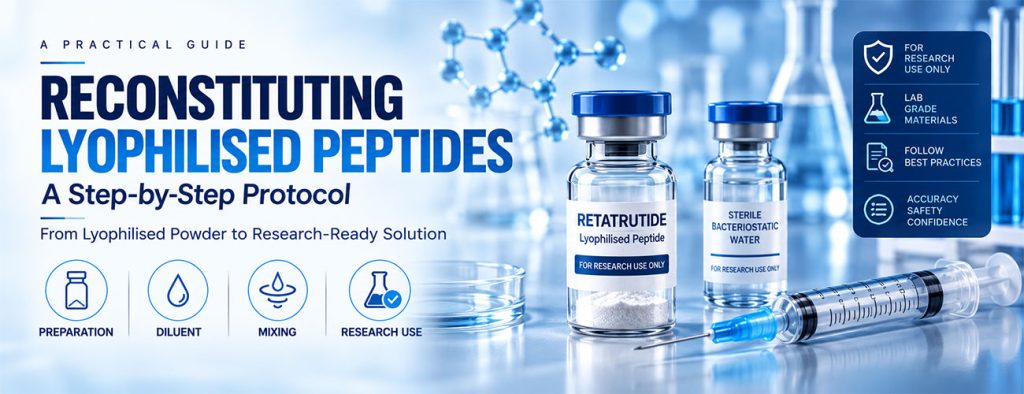
Lyophilisation, also known as freeze-drying, is widely used in laboratories to improve the stability of peptides and other sensitive biological materials. By removing water under controlled conditions, lyophilisation can help protect compounds during storage and transportation.
Before a lyophilised peptide can be used in many laboratory assays, however, it must be returned to solution. This process is known as reconstitution.
Although reconstitution appears straightforward, factors such as solvent selection, temperature, mixing technique, concentration calculations and storage conditions can affect peptide stability and experimental reproducibility.
This guide explains the fundamental principles researchers should consider when reconstituting lyophilised peptides in controlled laboratory environments.
What Is a Lyophilised Peptide?
A lyophilised peptide is peptide material from which water has been removed through freeze-drying.
During lyophilisation, the material is frozen before surrounding pressure is reduced. Water is then removed primarily through sublimation, allowing ice to transition directly into vapour.
The resulting material may appear as a dry powder, cake or film inside a laboratory vial.
Lyophilisation is particularly useful for compounds that may be less stable in aqueous solution. Nevertheless, freeze-drying does not make a peptide indefinitely stable. Temperature, moisture, light and repeated handling can still influence material integrity.
Researchers should therefore follow the storage conditions provided by the manufacturer or laboratory documentation for the specific material being studied.
Why Reconstitution Technique Matters
Reconstitution is more than simply adding liquid to a vial.
Peptides can differ considerably in their physicochemical properties. Their solubility and stability may be affected by amino-acid sequence, molecular weight, concentration, pH, temperature and solvent composition.
Poor handling can potentially contribute to problems such as incomplete dissolution, aggregation, contamination or degradation.
Consistency is equally important. If the same material is prepared differently between experiments, the resulting concentration or stability differences can introduce unwanted experimental variability.
A documented standard operating procedure (SOP) therefore helps laboratories maintain reproducible preparation methods.
Step 1: Review the Compound Documentation
Before opening or preparing a peptide vial, researchers should review the documentation supplied with the material.
Useful information may include:
- Peptide identity and sequence
- Molecular weight
- Stated purity
- Batch or lot number
- Certificate of Analysis (CoA)
- Recommended storage conditions
- Known solubility information
- Any compound-specific handling requirements
Do not assume that a preparation method suitable for one peptide will automatically be suitable for another.
Batch-specific analytical documentation is particularly useful for maintaining research traceability.
Step 2: Select an Appropriate Laboratory Solvent
Solvent selection should be based on the properties of the peptide and the requirements of the intended assay.
Purified laboratory water, sterile water, buffered solutions and other research-grade solvents may be appropriate depending on the compound and experimental protocol.
Bacteriostatic water is sometimes discussed in relation to peptide preparation, but researchers should not treat it as a universal solvent. Its composition may be unsuitable for certain analytical methods or experimental systems.
The peptide’s technical documentation and validated laboratory protocol should determine which solvent is used.
Step 3: Determine the Required Concentration
Researchers should establish the required experimental concentration before beginning reconstitution.
The fundamental calculation is:
For example, a laboratory working with 10 mg of research material and adding 2 mL of an appropriate solvent would theoretically produce a concentration of:
Important: This is simply a laboratory concentration calculation and should not be interpreted as dosing guidance.
Researchers working at micromolar or nanomolar concentrations may need additional calculations based on the peptide’s molecular weight.
Recording these calculations in the laboratory notebook or electronic laboratory information system improves traceability and reduces the likelihood of preparation errors.
Step 4: Add the Solvent Carefully
Once the required volume has been established, the solvent should be introduced using appropriate laboratory equipment and aseptic technique where the experimental protocol requires it.
Avoid unnecessary physical agitation.
Instead of aggressively shaking the vial, many laboratory protocols use gentle swirling or controlled mixing. Excessive agitation can be undesirable for some peptide or protein preparations because it may encourage foaming or aggregation.
If material does not dissolve readily, researchers should consult compound-specific solubility information rather than automatically increasing agitation or changing solvents.
Step 5: Confirm Complete Dissolution
After adding the solvent, visually inspect the preparation.
The expected appearance depends on the compound and solvent, but researchers should look for unexpected particles, precipitation, cloudiness or undissolved material.
Allowing sufficient time for dissolution may be necessary.
If precipitation occurs, the preparation should not automatically be assumed to have failed. Solubility can depend on factors including concentration, temperature, pH and ionic strength.
Any unexpected observations should be documented before further experimental use.
Step 6: Label and Document the Preparation
Good laboratory practice requires clear identification of prepared materials.
The vial or secondary container should be labelled according to the laboratory’s SOP. Relevant records may include the compound name, batch number, concentration, solvent, preparation date and researcher responsible for the preparation.
Accurate documentation creates a traceable connection between the original lyophilised material, its Certificate of Analysis and the experiments in which the reconstituted material is subsequently used.
This becomes particularly important when comparing results between different batches or experiments.
Step 7: Store According to Compound-Specific Requirements
Reconstitution can substantially change the stability profile of a peptide.
A material that remains comparatively stable while lyophilised may have a shorter useful lifetime once placed into solution.
Researchers should therefore follow validated compound-specific storage conditions rather than applying one general rule to every peptide.
Temperature, light exposure, container material and repeated freeze-thaw cycles can all influence stability.
Where repeated experimental access is required, laboratories may consider validated aliquoting procedures to minimise unnecessary handling of the primary preparation.
Common Reconstitution Errors
Several avoidable mistakes can undermine experimental consistency.
Using an unsuitable solvent is one of the most significant. Other problems include incorrect concentration calculations, vigorous shaking, poor temperature control, inadequate labelling and repeated uncontrolled freeze-thaw cycles.
Another common problem is assuming that every lyophilised peptide behaves identically. Peptides have different sequences and physicochemical characteristics, so solubility and stability should always be considered individually.
Researchers should also avoid relying solely on generic online instructions when compound-specific technical information or a validated laboratory SOP is available.
Reconstitution and Research Traceability
Reconstitution should form part of a broader system of laboratory documentation.
Ideally, researchers should be able to trace an experimental preparation back to its original batch, analytical documentation, storage history and preparation record.
For laboratories working with research peptides, this helps distinguish problems associated with experimental conditions from those potentially associated with material preparation or storage.
The same principle applies to analytical studies involving investigational compounds such as retatrutide. Researchers can explore our Knowledge Centre for further background on peptide research and read our guide to how retatrutide works for an overview of its GIP, GLP-1 and glucagon receptor activity.
Final Thoughts
Successful peptide reconstitution depends on controlled preparation rather than a universal formula.
Researchers should verify the identity and documentation of the material, select an appropriate solvent, calculate the required laboratory concentration, minimise unnecessary agitation and record the preparation carefully.
Most importantly, storage, solvent and handling decisions should be based on the properties of the individual peptide and a validated experimental protocol.
Consistent reconstitution practices help protect material integrity, improve traceability and reduce avoidable variability across laboratory experiments.
Scientific References
- Butreddy A, Janga KY, Ajjarapu S, Sarabu S, Dudhipala N. Instability of therapeutic proteins – An overview of stresses, stabilization mechanisms and analytical techniques involved in lyophilized proteins. International Journal of Biological Macromolecules. 2021;167:309–325. https://pubmed.ncbi.nlm.nih.gov/33275971/
- World Health Organization (WHO). WHO Good Practices for Pharmaceutical Quality Control Laboratories. WHO Technical Report Series No. 1052, Annex 4. 2024. https://www.who.int/publications/m/item/who-good-practices-for-pharmaceutical-quality-control-laboratories
- World Health Organization (WHO). Quality Assurance of Pharmaceuticals: A Compendium of Guidelines and Related Materials, Volume 1 – Good Practices and Related Regulatory Guidance. 10th edition. 2024. https://www.who.int/publications/i/item/9789240099425
- World Health Organization (WHO). Good Manufacturing Practices for Active Pharmaceutical Ingredients. WHO Technical Report Series No. 957, Annex 2. https://www.who.int/publications/m/item/annex-2-trs-957