Documentation Practices for Research Traceability
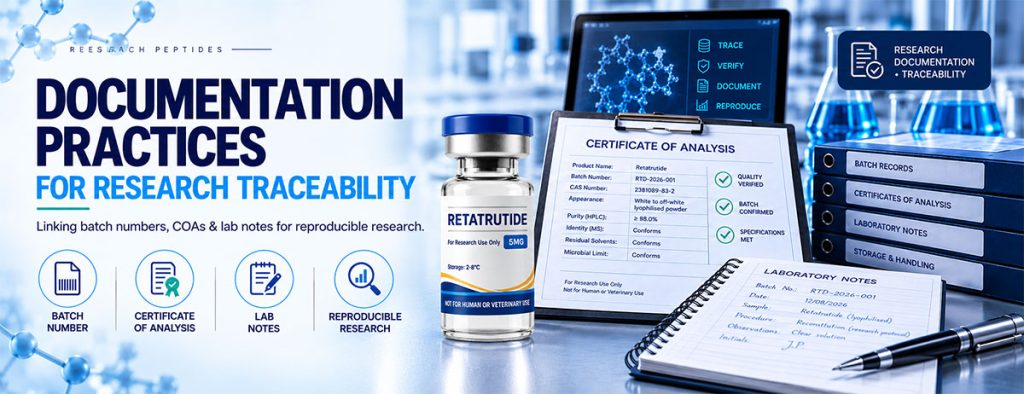
Reliable scientific research depends on more than obtaining a result. Researchers also need to understand where materials came from, how they were handled, what procedures were followed and how the resulting data were generated.
This is the purpose of research traceability. Good documentation creates a clear chain connecting a research material with its source, experimental use, analytical data and final observations. When records are complete and organised, another researcher should be able to understand how an experiment progressed without relying on memory or assumptions.
For laboratories working with research peptides and other analytical materials, traceability is particularly valuable because identity, batch information, storage conditions and experimental procedures may all influence how results are interpreted.
What Does Research Traceability Mean?
Research traceability is the ability to follow the history of a material, sample, experiment or dataset through documented records.
Depending on the research environment, this may involve recording:
- material and compound identity;
- supplier and source information;
- batch or lot number;
- Certificate of Analysis (CoA);
- date received and date opened;
- storage conditions;
- preparation or dilution information;
- equipment and analytical methods used;
- researcher responsible for the work;
- raw experimental observations;
- data processing and amendments.
The objective is to establish a documented link between the original research material and the data produced from it.
OECD Good Laboratory Practice (GLP) principles place considerable emphasis on documentation, raw data, study reporting and archiving because these records help make scientific work verifiable.
Start With Material Identification
Traceability should begin when a research material arrives rather than when an experiment starts.
The laboratory record should identify exactly what was received. This can include the product name, batch number, quantity, supplier, receipt date and any accompanying analytical documentation.
Where a Certificate of Analysis is supplied, retaining the batch-specific document alongside the laboratory’s material record can make it easier to connect subsequent experiments with the analytical information associated with that particular batch.
Researchers can learn more about the importance of analytical documentation in our Knowledge Centre.
A simple internal identifier can also be useful. For example, laboratories may assign each received material a unique sample code that follows it through preparation, analysis and storage.
Record Storage and Handling Conditions
A research material’s history does not end after receipt.
Documentation should record where and under what conditions the material was stored. Where relevant to the protocol, researchers may also document movements between storage locations, preparation dates and handling conditions.
This creates continuity between the original material and the sample eventually used during an experiment.
Good records become especially important where several batches of the same compound are held simultaneously. Without batch-level identification, researchers may later find it difficult to establish which material produced a particular dataset.
Researchers working with laboratory materials can view the current range available through our research shop.
Document Experimental Procedures as They Happen
Research notes are most useful when recorded contemporaneously rather than reconstructed afterwards.
The MHRA’s data-integrity guidance emphasises principles commonly summarised through ALCOA: data should be attributable, legible, contemporaneous, original and accurate. Broader ALCOA+ principles also address completeness, consistency, endurance and availability.
In practical laboratory documentation, this means recording enough information to establish:
- Who performed the work?
- What material and batch were used?
- When was the experiment conducted?
- Which protocol or method was followed?
- What equipment was used?
- What observations and results were obtained?
The precise level of detail will depend on the research environment and study design. The aim should be to create records sufficiently clear to reconstruct the relevant experimental activities.
Preserve Raw Data
Processed graphs, averages and summary tables can make research findings easier to interpret, but they should not become substitutes for the original experimental data.
Raw data may include instrument-generated files, chromatograms, measurements, laboratory observations, images or other original records.
OECD guidance highlights the importance of managing data across its lifecycle and considering data criticality, risks and appropriate controls.
Electronic systems can introduce additional considerations. Where data are changed, processed or transferred, appropriate metadata and audit trails can help establish what happened to the record and when.
Original records should therefore be retained wherever required by the laboratory’s research and quality procedures.
Keep Corrections Transparent
Mistakes can occur during research documentation. The important principle is that corrections should not obscure what was originally recorded.
For paper records, laboratories commonly use procedures that preserve the original entry while identifying the correction, date and person responsible.
Electronic systems may provide audit trails recording changes automatically.
OECD GLP guidance notes that computerised systems used for electronic raw data should allow changes to be traced without obscuring the original information, with changes associated with the person making them.
Transparent corrections help distinguish legitimate amendments from undocumented alterations.
Create a Consistent File Structure
Traceability becomes harder when documents are scattered across notebooks, local computers, email accounts and instrument folders.
A standardised structure can make retrieval considerably easier.
For example, records for an individual research project might contain:
- study or project identifier;
- research protocol;
- material and batch records;
- analytical documentation;
- preparation records;
- raw experimental data;
- processed data;
- analysis notes;
- deviations or amendments;
- final report.
Consistent naming conventions can further reduce confusion, particularly when multiple researchers contribute to the same project.
Protect and Archive Research Records
Traceability must continue after an experiment has finished.
OECD guidance recommends considering storage, retrieval, accessibility and protection against loss, damage or unauthorised alteration. Electronic information may also need appropriate backup and verification procedures.
Laboratories should therefore establish documented procedures covering record retention and archiving appropriate to their work.
Access controls can also be important. Researchers should be able to retrieve the information required for legitimate scientific purposes without allowing uncontrolled alteration of archived records.
Why Documentation Matters
Good documentation does not make an experiment scientifically valid by itself. It does, however, provide the evidence needed to understand how the experiment was conducted.
Effective research traceability can make it easier to investigate unexpected findings, compare results between batches, identify procedural differences and reproduce previous experimental conditions.
Ultimately, the principle is straightforward: a research result is more useful when its history can be reconstructed.
From material receipt and batch identification through experimental recording, raw-data preservation and long-term archiving, a consistent documentation system creates a transparent connection between research materials, procedures and results.
For laboratories, that traceable chain is an important foundation for organised, reproducible and interpretable research.
Disclaimer: This content is provided for educational and scientific research purposes only. It does not constitute medical advice. Research materials discussed are intended strictly for laboratory research and not for human consumption.
Scientific References
-
Medicines and Healthcare products Regulatory Agency (MHRA).
Guidance on GxP Data Integrity. GOV.UK.
https://www.gov.uk/government/publications/guidance-on-gxp-data-integrity -
UK Research and Innovation (UKRI).
Guidance on Best Practice in the Management of Research Data.
https://www.ukri.org/publications/guidance-on-best-practice-in-the-management-of-research-data/ -
Medical Research Council (MRC), UKRI.
Good Research Practice Policies and Guidance.
https://www.ukri.org/who-we-are/mrc/our-policies-and-standards/research/ -
UK Research and Innovation (UKRI).
Policy on the Governance of Good Research Practice.
https://www.ukri.org/publications/ukri-policy-on-the-governance-of-good-research-practice/policy-on-the-governance-of-good-research-practice/